How to swap ADA to USDT without KYC
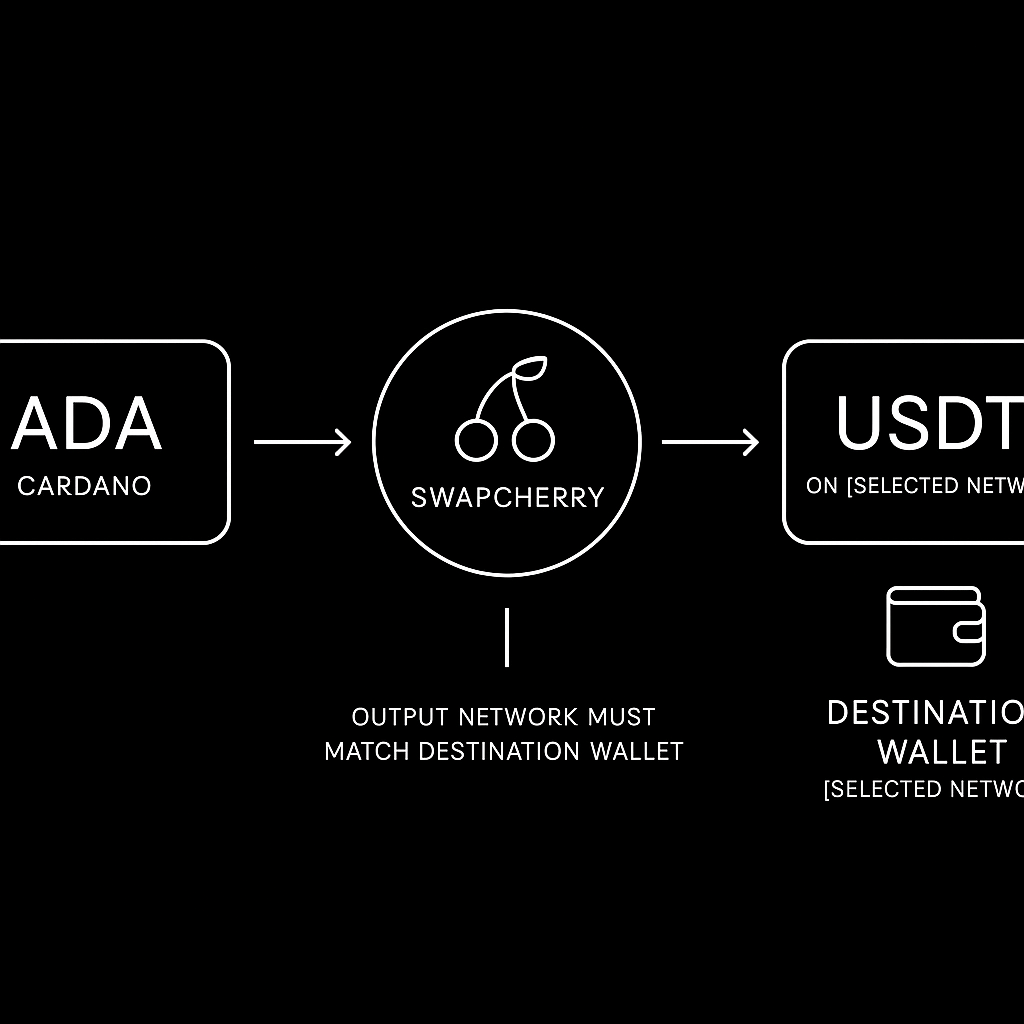
Swap ADA to USDT right here — live widget below.


Swap Cardano → Tether
Live rate · settles in minutes
Cardano has no native USDT. Swapping ADA for USDT therefore requires a cross-chain route before you open a wallet.
Use SwapCherry, choose the USDT network your destination wallet supports, review the final quote, send ADA, and receive USDT there without registration or KYC. SwapCherry shows a 0.5% platform fee before confirmation, and its published guide says most swaps complete in under two minutes, depending on network confirmations.
Choose the output network first. Then check the quote, send ADA, and save the transaction record. This guide explains the pair gap, compares the available routes, and walks you through the SwapCherry flow.
In this article
- Use SwapCherry, then choose the USDT network
- ADA and USDT are on different chains
- Why a no-KYC swap fits this pair better than building a bridge route
- Check the quote before sending ADA
- Select ADA, USDT, and the correct output network
- Enter and verify the destination wallet
- Send the requested ADA and wait for confirmation
- Run seven checks before broadcasting
- How much privacy does a no-KYC swap provide?
- Keep records of the ADA disposal and USDT receipt
- Choose SwapCherry when you need one cross-chain flow
Use SwapCherry, then choose the USDT network
Open the SwapCherry ADA-to-USDT page. Select ADA as the asset you send and USDT as the asset you receive. The destination wallet must support the exact USDT network shown in the quote.
SwapCherry describes three stages. Choose the pair and review the quote. Send ADA to the supplied deposit address. USDT then arrives in your destination wallet. No passport, selfie, residential address, or account registration is required to begin.
Say you’re converting $1,000 worth of ADA into USDT on Tron because your destination wallet supports USDT-TRC20. The order therefore needs to produce USDT on Tron.
The displayed quote includes SwapCherry’s 0.5% platform fee. Review the final USDT amount, network information, limits, and network cost before approving the order.
ADA and USDT are on different chains
ADA is native to Cardano. USDT exists on several networks, including Ethereum, Tron, BNB Chain, and Solana. Cardano has no native USDT.
Minswap, SundaeSwap, and WingRiders primarily trade Cardano-native assets such as iUSD, DJED, and USDA. A Cardano DEX can swap ADA into a Cardano-native stablecoin; it cannot directly hand you native USDT on Tron or Ethereum.
To receive USDT on another chain, you need cross-chain routing, a bridge, or a wrapped representation. Building that route yourself means managing a Cardano wallet, a destination-chain wallet, a bridge interface, and several confirmation steps. You also need to know whether the resulting token is native USDT or a wrapped representation.
If your destination specifically requires USDT-TRC20, a wrapped token on another chain won’t satisfy that requirement. Select the network and asset representation shown by the destination wallet.
For a one-off conversion, building this route yourself is needless operational overhead. That gap between the chain holding ADA and the chain where you need USDT is the whole problem SwapCherry is solving here.
Why a no-KYC swap fits this pair better than building a bridge route
For this transaction, the relevant question is whether you want to add a bridge and more failure points to a transaction that doesn’t require them.
SwapNoKYC’s comparison of swaps and DEXs describes some cross-chain swap services as using one frontend, avoiding per-chain wallet setup, and routing on each chain without requiring the customer to handle a wrapped token or bridge. SwapCherry’s published flow similarly presents one deposit-and-payout process.
A DEX can be cheaper for same-chain pairs with deep liquidity, especially for larger transactions. ADA-to-USDT has a different structure. A Cardano-native trade still leaves you needing another route to deliver USDT on Tron, Ethereum, or a different destination chain.
Bridge attacks have also been a major source of DeFi losses. The useful point is operational: every bridge, wallet, and confirmation adds another place to make a costly mistake.
For ADA to USDT, adding infrastructure for its own sake is the wrong kind of decentralization. A single-flow swap service removes several decisions from the transaction while preserving the user-controlled destination wallet.
Check the quote before sending ADA
The delivered amount matters more than a headline percentage. SwapCherry states that its platform fee is 0.5%, shown before confirmation and included in the displayed rate.
For a $1,000 swap:
$1,000 × 0.005 = $5
That implies a $5 platform fee before network costs. Your actual USDT receipt depends on the live exchange rate, liquidity, selected network, and transaction size.
SwapCherry says network fees are reflected in the final estimated amount. Current minimum and maximum limits depend on available liquidity and appear in the exchange widget.
An August 13, 2026 snapshot showed 1 ADA = 0.210480 USDT on the SwapCherry pair page. That rate is not used to promise a $1,000 output; the live widget determines the amount when you create the order. Rates move.
Before confirming, compare:
- Final amount received: the USDT that will reach your wallet
- Displayed fee: including the 0.5% platform fee
- Network cost: included in the final estimate according to SwapCherry
- Limits: minimum and maximum order size
- Destination network: the chain your wallet supports
- Quote conditions: including any expiry or rate-lock information
The competitor figures below come from provider marketing pages surfaced in secondary research. Treat them as self-reported snapshots. They are not verified performance data. SwapCherry’s figures are company-published claims as well.
| Service | Published fee or pricing claim | Published timing claim |
|---|---|---|
| SwapCherry | 0.5% platform fee | Most swaps under two minutes |
| Swap.bz | 0.2% service fee | Most swaps under five minutes |
| SwiftSwap | 1% fee | Settles in under three minutes |
| NativeSwap | About 0.1–0.15% service fee | Not stated |
| GhostSwap | 0.1–0.2% spread | Most swaps about eight minutes |
These figures don’t account for the live spread, network cost, order size, or destination network, so they cannot establish which service is cheapest. A cheaper percentage is irrelevant if the delivered USDT is lower.
The 0.5% fee is only one input. I haven’t measured every competitor’s live spread, liquidity, or network charge, so your executed quote remains the deciding evidence.
Select ADA, USDT, and the correct output network
Open the exchange page directly, then choose ADA as the asset sent and USDT as the asset received. Select one of the networks shown in the live quote and supported by your destination wallet.
For the $1,000 illustration, select USDT on Tron because the receiving wallet supports USDT-TRC20. “USDT” alone leaves out the network label that determines whether the receiving wallet can use the funds.
Review the exchange rate and estimated amount before continuing. Check the displayed fee, network information, and limits too. If the wallet supports only Ethereum, choose USDT on Ethereum instead. If it supports several networks, select the one you intend to use and verify that choice again before sending.
Enter and verify the destination wallet
Open the receiving wallet’s Receive screen and copy its address. Don’t type it from memory.
Confirm that the wallet supports the exact USDT network selected in the order. Paste the address into the destination field. Compare the complete address before continuing, checking the string from start to finish.
SwapCherry needs a destination address. It doesn’t need your seed phrase or private key. Never enter either into a swap interface.
For the platform’s full process and safety guidance, read “Swap crypto on SwapCherry without KYC”.
Stop if anyone requests a seed phrase, private key, unexpected extra payment, or unrelated identity document. Those requests fall outside the normal swap flow.
Send the requested ADA and wait for confirmation
After you confirm the order, SwapCherry provides an ADA deposit address.
Send only ADA over Cardano. Before broadcasting, compare the deposit address shown in the order with the address in your wallet, then verify the amount.
Use an amount you can afford to have delayed while the network confirms. SwapCherry says most swaps complete in under two minutes, but confirmation time and routing conditions can extend that estimate.
Keep the order ID and transaction hash if one is provided. Don’t send a second payment because the first one hasn’t completed. Wait for the order status or inspect the transaction on the relevant blockchain explorer.
After the deposit is confirmed and the route completes, USDT is sent to the destination address and network selected in the order.
Run seven checks before broadcasting
Use this checklist immediately before sending:
- Asset: your wallet is sending ADA, exactly as the order requests.
- Deposit network: the ADA is being sent over Cardano.
- Output network: the selected USDT chain matches the receiving wallet.
- Destination: the full address matches the wallet’s receive screen.
- Quote: the final USDT amount, fee, limits, and network cost are acceptable.
- Site: you reached SwapCherry through its typed official domain or bookmark.
- Requests: nobody has asked for credentials, an unrelated document, or an extra payment.
ETH on Ethereum differs from an asset represented on another network, even when the name looks familiar. USDT follows the same rule.
Reach the official site by typing the address directly or using a bookmark. Search ads, social-media posts, and lookalike domains are poor ways to begin a financial transaction.
How much privacy does a no-KYC swap provide?
A no-KYC swap reduces the amount of identity information collected during onboarding. The blockchain still records the transaction. Wallet addresses can sometimes be connected through transaction patterns and clustering analysis.
For U.S. federal tax purposes, SwapCherry’s tax guide summarizes federal guidance that generally treats cryptocurrency as property. The facts of the transaction matter. Exchanging ADA for USDT is generally a disposal of the ADA, similar to selling ADA for dollars and using the proceeds to acquire USDT.
A wallet-to-wallet transfer without a sale or exchange is generally treated differently from exchanging ADA for USDT. Section 1031 also doesn’t provide a general post-2017 deferral for crypto exchanges.
Privacy from corporate data collection is a legitimate interest. Concealment from tax authorities is a different matter, and an on-chain swap leaves a record.
This is general U.S. information, not a determination of your tax result. Readers outside the United States need advice based on local rules. Complex transactions, business activity, and unusual cost-basis situations deserve a qualified tax professional.
Keep records of the ADA disposal and USDT receipt
Save the details immediately after the swap. For the $1,000-worth-of-ADA illustration, keep:
- UTC date and time
- Amount of ADA disposed of
- ADA acquisition date and cost basis
- USDT received and its fair market value
- Platform and network fees
- Sending and destination addresses
- Transaction hashes
- SwapCherry order ID
- A copy of the quote or order confirmation
If the executed swap value is $1,000, that figure is a starting point for measuring the ADA disposal; your gain depends on basis and the applicable fee treatment.
If the ADA disposed of in a swap had a $600 basis and was exchanged at a $1,000 value, the potential gain would be $400 before applicable adjustments. The holding period affects short-term or long-term treatment under U.S. rules.
Rev. Proc. 2024-28 supports tracking basis by wallet; a single pooled record may fail to preserve the wallet-specific history needed for some transactions. Keep the order data with the records for the wallet that sent the ADA.
A no-KYC transaction still needs a recordkeeping system. Without an account statement, your own order details become especially useful.
Choose SwapCherry when you need one cross-chain flow
SwapCherry suits a reader who wants to swap Cardano ADA for USDT without registration, review a displayed 0.5% platform fee, and receive the result in a compatible destination wallet.
This is precisely the kind of awkward cross-chain job a single-flow swap service is suited to. You don’t need to assemble a bridge route or convert ADA into a Cardano-native stablecoin first.
Use a Cardano DEX instead when you only need a Cardano-native asset and want to stay entirely on Cardano. Use a regulated exchange when your jurisdiction, reporting needs, or order size requires its custody or compliance process.
SwapCherry reports support for more than 1,500 cryptocurrencies, 100,000+ users, 2 million+ swaps, 99.9% uptime, and cold storage. These are company-published figures. They have not been independently verified.
Before broadcasting, say the route aloud: “ADA over Cardano in; USDT over [network] out; this address supports that network; the displayed receipt and limits work for me.” Save the quote and transaction hash immediately afterward.