How to swap crypto on SwapCherry without KYC
Swap BTC to XMR right here — live widget below.


Swap Bitcoin → Monero
Live rate · settles in minutes
In this article
- Swap crypto faster without creating an account
- The swap takes three steps
- No KYC improves privacy, but it does not make a swap invisible
- No KYC does not remove US tax obligations
- Use the same safety habits for every crypto swap
- Your SwapCherry no-KYC questions answered
Swap crypto faster without creating an account
So choose the BTC-to-ETH pair on SwapCherry, send BTC to the order address, and provide the ETH wallet that should receive the funds.
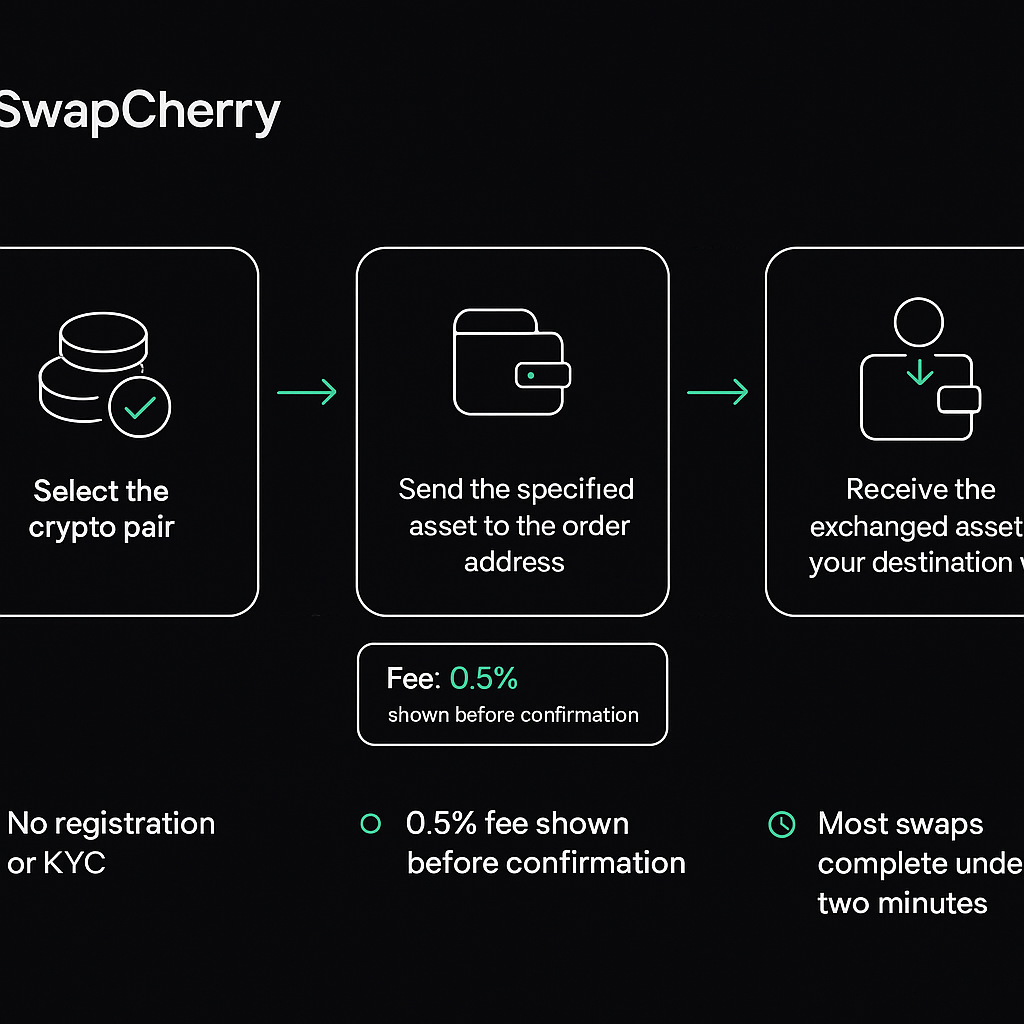
SwapCherry is the practical way to swap crypto without registration or KYC: it advertises support for 1,500+ cryptocurrencies, a 0.5% fee shown before confirmation, and completion of most swaps in under two minutes. The service describes itself as non-custodial, so you provide the destination wallet for the exchanged asset rather than opening an account to hold funds.
SwapCherry says it has served more than 100,000 users and processed over 2 million swaps. And it reports 99.9% uptime, along with industry-leading security protocols and cold storage for funds.
The fee is easy to calculate. And a $1,000 swap at 0.5% carries a $5 platform fee before any applicable network costs.
Most no-KYC guides make this harder than it is. So start with the pair, then check the deposit and destination wallet. For taxes, document what you disposed of and what you received. This guide walks through the SwapCherry flow, explains what no KYC does to privacy, covers US tax basics, and ends with a safety checklist for any crypto transaction.
The swap takes three steps
The published SwapCherry flow is simple: select the pair, send crypto to the provided address, and receive the exchanged asset in your wallet. But check the address and network carefully. A careless click can become an expensive transaction.
-
Select the pair and review the quote. Choose the cryptocurrency you want to send and the cryptocurrency you want to receive. For example, select BTC as the source asset and ETH as the destination asset.
Check the network on both sides. ETH on Ethereum is different from an asset represented on another network, even when the name looks familiar. Your destination wallet must support the exact asset and network shown for the order.
SwapCherry advertises a 0.5% platform fee shown before confirmation. Network costs can apply separately, depending on the blockchains involved. Review the quoted amount, fee, and expected destination amount together.
Compare the quote with two independent market-data screens as a rough price check. Prices move, so the comparison won’t match perfectly. It can still expose an obvious mistake.
Enter the destination address from a trusted source, such as the wallet’s receive screen. Copy it rather than typing it from memory.
-
Send the requested asset. SwapCherry provides a deposit address for the order. Send only the requested asset, over the requested network, and follow the timing shown for that order.
For a BTC-to-ETH swap, send BTC to the Bitcoin deposit address generated for the order. Don’t send ETH, USDT or BTC over another network just because the address looks familiar. Blockchains are impressively consistent about refusing to fix human mistakes.
Before broadcasting, compare the full deposit address and network on the order page with the details in your wallet. This is also the moment to confirm the amount. Save the order ID. Record the source asset, destination asset and quoted fee. Keep the deposit address, destination address, and amount too.
-
Receive the exchanged asset. SwapCherry sends the exchanged cryptocurrency to the destination wallet address you entered. Most swaps complete in under two minutes, according to SwapCherry, while the exact timing depends on network confirmations.
For the BTC-to-ETH example, verify that ETH arrives on the intended network. Check the destination wallet and, if needed, the relevant block explorer for the transaction hash, amount, and recipient address. If the wallet display lags, check the transaction hash on the relevant block explorer.
Reach the official site by typing the address directly or using a bookmark. Search ads, social-media posts, and lookalike domains are poor ways to begin a financial transaction.
No KYC improves privacy, but it does not make a swap invisible
People routinely collapse privacy and anonymity into one promise. They’re different properties.
No KYC means less onboarding information is collected. SwapCherry doesn’t require passport details, a selfie, a residential address, or account registration to begin the swap. That’s a legitimate privacy benefit.
The underlying blockchain still records its activity. Depending on the network, the public ledger can show wallet addresses and amounts. It can also record token movements and smart-contract calls. Timestamps and transaction fees appear there too.
Wallet addresses are usually pseudonymous. An address doesn’t automatically display your name, while transaction patterns and clustering analysis can sometimes connect addresses with one another or with a known identity.
As LeoDex explains, “Privacy from corporate data collection... is a legitimate interest. Concealment from tax authorities is a different thing entirely, and nothing about a transparent on-chain swap conceals anything anyway.”
Your privacy depends on the blockchain, wallet habits, other services you use, and information connected to your addresses. No-KYC is a privacy feature, not invisibility.
No KYC does not remove US tax obligations
The platform’s KYC policy is irrelevant to whether you disposed of an asset. The tax rule is straightforward even when the interface is not: swapping ETH for BTC is generally a disposal of ETH. The result is similar to selling ETH for dollars and buying BTC.
The IRS’s Notice 2014-21 treats cryptocurrency as property for federal tax purposes. When you exchange one cryptocurrency for another, the fair market value of what you receive is generally compared with the cost basis of what you dispose of to determine a potential gain or loss.
A BTC-to-ETH swap can create a short-term gain
Suppose you acquired BTC three months ago for $600. At the time of the SwapCherry order, that BTC has a fair market value of $1,000, and you exchange it for ETH.
Fair market value of BTC at disposal:  $1,000
Cost basis:                              -$600
Potential gain:                           $400
Because you held the BTC for three months, the $400 potential gain is generally short-term. Short-term gains are generally taxed at ordinary-income rates. Holding an asset for more than one year generally places a gain in the long-term capital-gains framework.
The $1,000 figure is the BTC’s fair market value at disposal. It isn’t necessarily the amount of ETH received after platform and network costs. Record platform and network fees separately; their treatment can depend on how the fee is paid and the transaction structure. A tax professional can apply the rules to your facts.
Crypto swaps generally don’t qualify for Section 1031 like-kind deferral. Post-2017 rules limit that treatment to real estate, so exchanging one token for another doesn’t postpone the gain merely because both assets are crypto.
A transfer between wallets you own is generally different. Moving BTC from one of your wallets to another is generally not a taxable disposal because you haven’t sold or exchanged the asset.
The DeFi broker rule and custodial reporting rule are separate
According to LeoDex’s tax explainer, Treasury finalized TD 10021 in December 2024 as a DeFi-broker reporting rule. Public Law 119-5 repealed it on April 10, 2025, and Treasury removed it from the regulations in July 2025. The repealed rule would have treated certain DeFi front ends as brokers subject to KYC and Form 1099-DA reporting.
TD 10000 is separate. It remains relevant to custodial exchanges and hosted-wallet providers. Those providers report gross proceeds from 2025 trades, with the first forms filed in early 2026; cost-basis reporting is added for 2026 trades. Early forms may show proceeds without your basis, so you may need to supply the basis yourself on Form 8949.
The practical takeaway is plain: a non-custodial platform doesn’t issue an automatic 1099-DA under the repealed DeFi-broker rule. A missing 1099 means the platform does not report automatically, while the tax still applies.
The IRS digital-asset question on Form 1040 still applies to the activity described in the form. Answer it accurately. A platform’s reporting policy doesn’t decide whether your exchange was taxable.
Keep records for each wallet
Rev. Proc. 2024-28 applies allocation rules to digital assets held across wallets and accounts. A universal pool of basis records may be insufficient; preserve wallet-specific records showing where the asset was held and how its basis was calculated.
The most overrated crypto advice is “no KYC means no records.” Your tax records still follow the wallet and the transaction.
For each swap, save:
- UTC date and time
- Asset sold, amount, cost basis, and acquisition date
- Asset received, amount, and fair market value at execution
- Platform and network fees
- Deposit and destination addresses
- Transaction hashes
- Order ID, quote, and amount
For the BTC-to-ETH example, preserve the BTC acquisition record showing the $600 basis, the quote showing the exchange value and platform fee, the BTC deposit hash, and the ETH receipt hash.
Federal tax authorities use reporting information and blockchain analytics in enforcement. General federal penalties can include an accuracy-related penalty of 20% of an underpayment. A civil fraud penalty can reach 75%. Deliberate tax evasion can also bring criminal consequences.
This guide cannot calculate your tax bill from a swap alone. Basis and fees can change the result. So can your holding period, other disposals or state residence. Your activity and residency determine the tax obligations, so take complex activity to a qualified tax professional.
Use the same safety habits for every crypto swap
The procedure is short, so make the final check short too. Use this scan before and after sending:
Before sending
- Pair: Confirm the source asset and destination asset.
- Network: Match the network on the order, the sending wallet, and the destination wallet.
- Addresses: Compare the full deposit and destination addresses immediately before broadcasting.
- Quote: Review the quoted amount, platform fee, network costs, and timing shown for the order.
- Amount: Send only the requested asset and amount.
After sending
- Receipt: Confirm the destination wallet received the expected asset on the intended network.
- Records: Save the order ID, quote, UTC timestamps, fees, addresses, and both transaction hashes.
- Requests: Stop if anyone asks for a seed phrase, private key, unexpected extra payment, or unrelated identity document. Verify the request through the official site before doing anything else.
Use an amount you can afford to have delayed while a network confirms. That’s sound practice for every crypto transaction.
Your SwapCherry no-KYC questions answered
Can I use SwapCherry without an account?
Yes. SwapCherry states that registration and KYC aren’t required. You select the pair, send the requested crypto, and provide the wallet address that should receive the exchanged asset.
How much does SwapCherry charge?
SwapCherry advertises a 0.5% platform fee, shown before confirmation. A $1,000 swap therefore carries a $5 platform fee, before network costs.
How long does a swap take?
Most swaps complete in under two minutes, according to SwapCherry. Network confirmations determine the exact timing.
Is using a service without identity verification legal in the US?
For a US individual, using a service that doesn’t request identity verification is generally not illegal by itself. Sanctions, fraud, state law, and the facts of the transaction can matter, so this is a general overview rather than legal advice.
Is no KYC the same as anonymous?
No. It reduces onboarding data collection, while public-chain activity remains visible and analyzable.
Do I owe tax on a no-KYC swap?
Generally, a US crypto-to-crypto exchange is a taxable disposal of the asset you sent. Keep your own records even when you don’t receive a 1099-DA.
Before broadcasting, read the pair, network, amount, and full address aloud from the order page. After settlement, save the order ID, two hashes, timestamps, fees, and wallet-level basis.