How to choose the right crypto swap for your goal
Swap BTC to XMR right here — live widget below.


Swap Bitcoin → Monero
Live rate · settles in minutes
People keep explaining crypto with price charts. That’s backwards. Most people ask “why swap crypto?” because they own one token and need another for a payment, DeFi, savings, gaming, or investment.
A swap is the enabling step between holding an asset and giving it a job. SwapCherry is designed for fast swaps, charges a 0.5% fee, and requires no KYC or registration.
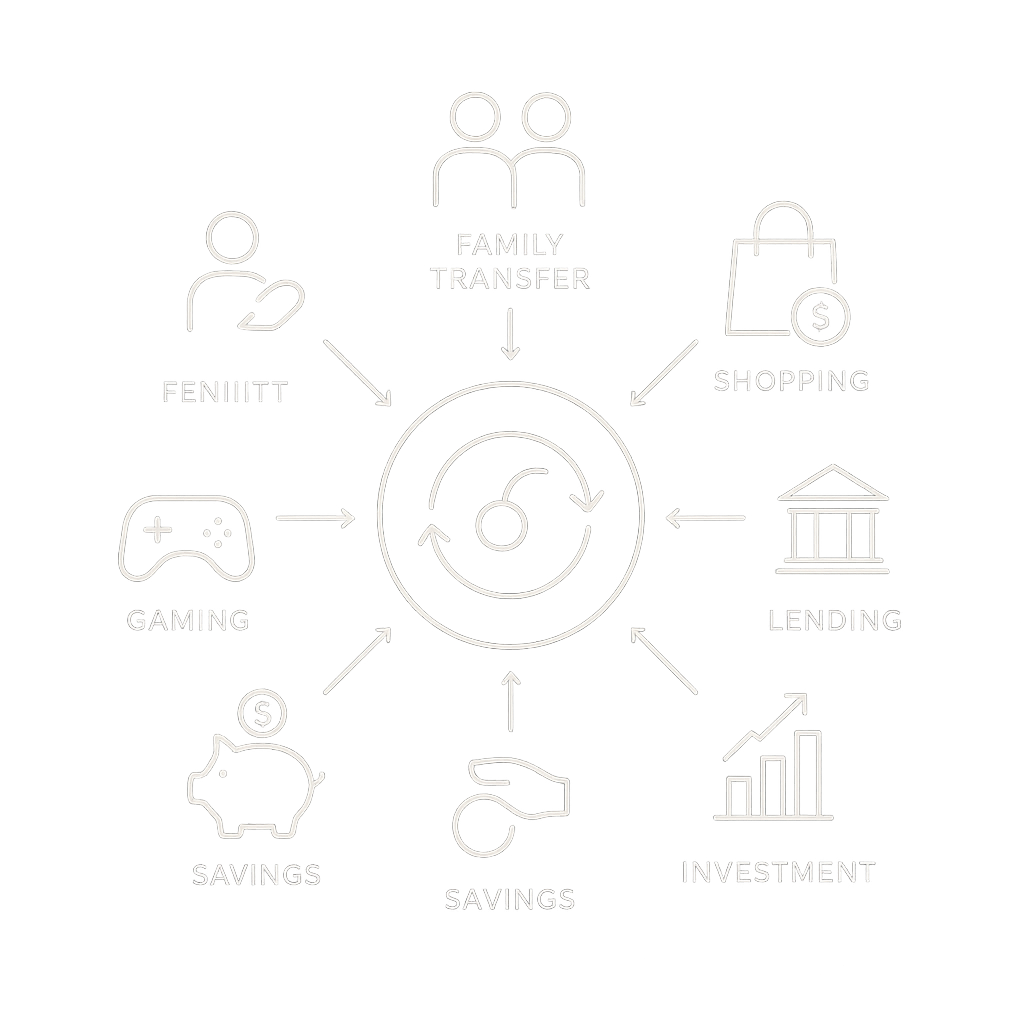
So this guide connects seven crypto use cases to the token type each one generally needs. It also gives you a simple way to decide what to swap and what to check first.
So you swap crypto when the token you hold cannot perform the next job. You might move from Ether into a stablecoin for a transfer, into a supported asset for DeFi, or into a game or tokenized-asset token. SwapCherry lets you make that change quickly for a 0.5% fee, without registration or KYC.
In this article
- Swapping connects what you hold to what you need
- Reported use is growing, but holder counts prove little
- 1. You can send money without using the same bank
- 2. Stablecoins make cross-border transfers the clearest payment case
- 3. The payment rail decides which token is useful
- 4. DeFi borrowing uses collateral instead of a bank application
- 5. Bitcoin and stablecoins serve different savings goals
- 6. Gaming and NFTs need a compatible ecosystem
- 7. Tokenization puts familiar assets on programmable rails
- Seven use cases help only if they change your next action
- The checklist protects the decisions around your swap
- Swap when the next token has a job
Swapping connects what you hold to what you need
Maya holds Ether but wants to send money to a relative abroad. Her relative needs a dollar-linked stablecoin on a particular network. The specified stablecoin fits that payment request better than Ether. Maya swaps ETH for the requested asset, checks the network and address, then sends it.
So the basic answer to why people swap crypto is simple: the next job requires a different token.
The National Cryptocurrency Association’s 2026 report found that 41% of US holders classify their crypto use across all three roles: investment, payment, and technology. Its phone analogy describes crypto as a system for messaging, payments and entertainment. The swap determines which asset can perform the next function.
A swap isn’t automatically a trading strategy. Often, it’s the practical step between owning one token and needing another.
Reported use is growing, but holder counts prove little
The survey’s useful surprise is its scale. 10,000 US holders reported their activity between February 12 and March 3, 2026. The report estimates that 67 million Americans hold crypto, roughly one in four US adults, after 12 million new holders joined in the previous year.
The share reporting no practical use fell from 20% to 13%. That suggests reported activity is broadening. It doesn’t show that every use case beats its conventional alternative on cost, safety or quality.
A larger holder count tells you how many people own crypto; it says almost nothing about whether crypto solved a problem for them. The survey measures what holders report. You’ll still need to measure the route, fees, network conditions, and local rules for your transaction.
Global counts vary too. Paybis estimates 559 million worldwide holders/users. DataWallet, citing a Crypto.com estimate, reports 741 million global owners in 2025. The methodologies differ, so treat both as directional rather than perfectly comparable.
The useful question is narrower: what do you need the token to do?
1. You can send money without using the same bank
Maya’s relative doesn’t need Ether; they need a dollar-linked token their wallet accepts.
The NCA found that 41% of US holders send crypto to friends or family, up from 31% the previous year. A transfer might cover a gift or shared expense. It might also go to someone who prefers a wallet to a bank payment app.
Her wallet contains ETH. Her relative has requested a particular stablecoin on a particular network. She swaps into that asset. Then she confirms the network, copies the recipient’s address, and sends the funds.
On-chain transfers may settle in minutes, depending on network conditions. The recipient may still need an exchange or payout provider to convert the funds into local currency.
Check the address and network before sending. Crypto transactions are generally irreversible. A transfer sent through an unsupported network may be difficult or impossible to recover. When the recipient has specified an asset and network, those details are part of the payment instructions.
2. Stablecoins make cross-border transfers the clearest payment case
Different currencies, payment systems, business hours, and fees create friction across borders. Stablecoins address part of it by representing value as a blockchain token that can move between compatible wallets.
Deep Blue Alpha uses a rough comparison of traditional remittance services charging 5–10% and taking three to five business days. Your route may differ substantially by country, provider, amount, payout method or funding source.
Traditional route: the cited comparison puts fees at 5–10%, with transfers taking three to five business days.
Stablecoin route: you pay the swap fee and network fee, then wait for on-chain settlement, which may take minutes under suitable conditions.
That speed applies to the on-chain leg. The recipient may still wait for cash-out, local settlement, or compliance checks.
Stablecoins such as USDC or USDT generally fit this job better than volatile assets. They aim to track a fiat currency, though the peg and redemption path still carry issuer and market risk. Sending Bitcoin can expose the recipient to a price change before conversion; a stablecoin is usually easier to budget around.
Maya’s ETH-to-stablecoin swap is the enabling action. Her current token and her relative’s requested payment asset serve different purposes.
The scale remains modest relative to global payments. The IMF places the global cross-border payment market at roughly $1 quadrillion in 2024, with crypto representing a small fraction. That denominator includes the entire cross-border payments market, so it isn’t a direct remittance comparison.
For narrower estimates, CoinLaw puts crypto-powered remittances at $27.87 billion in 2025 and projects $34.96 billion for 2026. The Business Research Company projects the market reaching $85.77 billion by 2030. These estimates use different methods and definitions.
3. The payment rail decides which token is useful
The wallet balance is irrelevant if the payment rail rejects the asset.
The NCA found that 40% of US holders shop for goods or services with crypto. Paybis offers a broad secondary estimate that 46% of merchants globally accept crypto. Treat that figure as directional. Acceptance varies by country, processor, and payment method.
You hold ETH. The merchant accepts USDC on a specified network. You need to swap into USDC and may also need the blockchain’s own token to pay transaction fees.
Read the merchant’s instructions beside your wallet’s network selection. A processor may support USDC on one network while rejecting the same stablecoin on another. Bitcoin isn’t the answer to every payment problem. When a merchant supports a stablecoin, that is often the more obvious payment tool.
Swap into the merchant-supported asset only after confirming the network and destination details. The useful token is the one the payment system can receive.
4. DeFi borrowing uses collateral instead of a bank application
DeFi lending protocols let users supply assets to smart contracts and borrow against collateral. The flow is straightforward:
Supply collateral, borrow, then repay
Suppose a protocol accepts USDC as lending liquidity and ETH as collateral. You can swap into the supported asset, connect your wallet, deposit it, and follow the protocol’s rules.
Borrowers generally provide collateral worth more than the amount borrowed. If the collateral falls below the required threshold, liquidation rules may sell it. You avoid a conventional credit application. You remain responsible for collateral, interest and liquidation risk.
Flash loans use zero collateral only because they must be repaid within the same transaction. They’re an advanced mechanism, not a beginner’s borrowing shortcut.
The DeFi Education Fund’s guide explains the basic model: smart contracts enforce the programmed conditions, while users supply assets and accept the protocol’s risks.
Centralized platforms can be easier to use, but they hold assets on your behalf. With self-custody, the wallet’s keys control the assets. Every approval, deposit and withdrawal becomes your responsibility.
Protocol scale is context rather than reassurance. Deep Blue Alpha reports that Aave had more than $25 billion in ecosystem TVL across more than 12 networks by May 2026. Scale doesn’t remove smart-contract, governance, liquidation, stablecoin, or network-fee risk.
Supply rates and borrowing rates change with market conditions. Any advertised APY is a variable observation, not a promised return.
5. Bitcoin and stablecoins serve different savings goals
The NCA reports that 54% of holders cite financial independence as a benefit. Forty-two percent cite security or control, up from 35%.
Those motivations can lead to different tokens.
| Asset type | What people may be seeking | Main trade-off |
|---|---|---|
| Bitcoin | Long-term exposure to a scarce digital asset | Significant price volatility and custody responsibility |
| Stablecoin | A short-term balance designed to track a fiat currency | Issuer, reserve, regulatory, custody, and depegging risks |
Someone seeking long-term exposure to digital scarcity may swap into Bitcoin. Someone preparing for a near-term payment may swap volatile crypto into a dollar-linked stablecoin so the amount is easier to plan.
In a high-inflation environment, a stablecoin may provide access to a dollar-denominated balance. It doesn’t guarantee protection from inflation, eliminate local conversion risks, or function as insured cash.
Both choices bring different volatility, issuer, custody, regulatory, and tax considerations. The NCA also found that 72% of holders worry about scams. That concern belongs in the decision. Choose a service you understand. Check transaction details and keep control of your records.
6. Gaming and NFTs need a compatible ecosystem
In a compatible game, a token can pay for an item or network fee, while an NFT can represent an in-game asset.
The NCA measured crypto-gaming activity at 28% of holders, up from 20%. NFT activity stood at 30%, down from 32%. Those figures show participation and cooling interest in one category; they don’t establish resale value or lasting utility.
A player might hold ETH but need a game-supported token to buy an item. The swap provides that ecosystem-specific currency. The token may function inside the game and nowhere else.
Ownership also has boundaries. An NFT may represent an asset within one platform. It doesn’t guarantee access outside it, a buyer when you sell or a profitable market. Check the game’s supported token, network, and withdrawal rules before swapping.
7. Tokenization puts familiar assets on programmable rails
Tokenization represents an asset or financial interest through a blockchain-based token. The reference might be a Treasury product, real estate exposure, or a gold-linked asset.
This is where crypto marketing gets especially slippery: exposure to an asset is not the same as owning it.
The tokenized US Treasury market illustrates the growth. Deep Blue Alpha reports roughly $6 billion in tokenized Treasuries by early 2026, up from less than $1 billion in 2023. It also reports BlackRock’s BUIDL above $2.5 billion in assets under management.
The number matters less than the terms attached to the product. A tokenized Treasury product may grant rights defined by its issuer. A property token may represent a fractional interest under specific legal arrangements. A gold-linked token depends on its reserves and redemption rules.
Eligibility, liquidity, fees, jurisdiction, and redemption terms vary. A token doesn’t automatically give you the same rights as holding the underlying asset directly.
If a product accepts a particular stablecoin or RWA token, you may need to swap into that asset before reviewing the offering. Read the issuer’s terms first. No guide can tell you which product fits without knowing your country, time horizon, and tolerance for loss.
Seven use cases help only if they change your next action
Seven use cases are only useful if they help you decide what to do next. Use this table as a starting point, not a universal prescription or personal financial advice.
| Your goal | Token type to investigate | Why swapping may be needed |
|---|---|---|
| Send to family | Stablecoin or recipient-supported asset | Your current asset may be volatile or unsupported |
| Cross-border remittance | Stablecoin | Reduces exposure to price movement during transfer |
| Merchant payment | Merchant-supported coin or stablecoin | Payment systems often require a specific asset and network |
| DeFi lending | Supported stablecoin or collateral asset | Protocols accept selected assets |
| Savings or inflation response | Stablecoin or Bitcoin, depending on horizon | The choice changes spending stability or investment exposure |
| Gaming | Game- or network-supported token | Assets are often ecosystem-specific |
| Tokenized-asset investment | Issuer-supported stablecoin or token | Access depends on the product and jurisdiction |
Choose the use case first. Then identify the token, network, issuer, and rules attached to it.
The checklist protects the decisions around your swap
- Define the job. Decide whether you’re sending money, remitting funds, paying, lending, saving, gaming, or accessing a tokenized asset.
- Confirm the required asset. Ask the recipient, merchant, protocol, game, or issuer which token and network it supports.
- Check the transaction details. Review the amount and destination details. Check the network, displayed fee and price impact too. Price impact means the difference between the quoted rate and the amount you’ll receive.
- Use SwapCherry. Make the exchange through SwapCherry and review the quoted terms. Its 0.5% fee is separate from any network fee shown for the transaction.
- Review before confirming. Read the final details again. This is the boring step that prevents expensive mistakes.
- Save the record. Keep the swap and transfer details for personal tracking and tax reporting.
A basic non-custodial swap may avoid opening a traditional exchange account. With self-custody, control follows the wallet’s keys, so a wrong address or network selection is usually your problem to absorb.
Crypto-to-crypto swaps may create tax reporting obligations in many jurisdictions. Rules differ, so keep the transaction records and check the guidance that applies where you live.
Swap when the next token has a job
Crypto has practical uses, though each one carries its own risks. Which use case is genuinely useful to you? What risk comes with it?
Before you swap, complete this sentence:
“I need [token] on [network] to [job].”
If you can’t fill in all three blanks, pause. If you can, verify the address and fee, make the asset change in SwapCherry, and keep the transaction record. That is why people swap crypto. The swap makes the intended use possible.