No-KYC crypto swaps are still taxable
Swap BTC to XMR right here — live widget below.


Swap Bitcoin → Monero
Live rate · settles in minutes
A no-KYC crypto swap can still create a taxable disposal. The key facts are the asset you gave up, its basis, its value when exchanged, and the country where you’re tax resident.
Crypto tax advice keeps treating the missing 1099 as a permission slip. That shortcut is wrong. And No KYC is a privacy feature, not a tax category; the missing form says nothing about whether tax is due. That is the rule behind no-KYC crypto swaps tax reporting.
The practical timeline matters. So US brokers may report proceeds for 2025 trades in 2026, basis reporting begins for 2026 trades, DAC8 data collection covers the 2026 EU calendar year, and UK CARF exchanges are expected in 2027. This guide separates the US, UK, and EU basics, then gives you an evidence workflow. It’s educational information, not individual tax advice.
In this article
- No-KYC changes who collects data, not whether the swap is taxable
- The tax calculation starts with the asset you gave up
- In the US, a crypto-to-crypto swap goes on the capital-gains track
- The UK taxes the disposal, with different matching rules
- The EU is one reporting area, not one tax regime
- “No KYC” does not mean invisible
- Your records are the bridge between a private swap and a defensible return
- If you have missed swaps, correcting the record is better than hiding them
No-KYC changes who collects data, not whether the swap is taxable
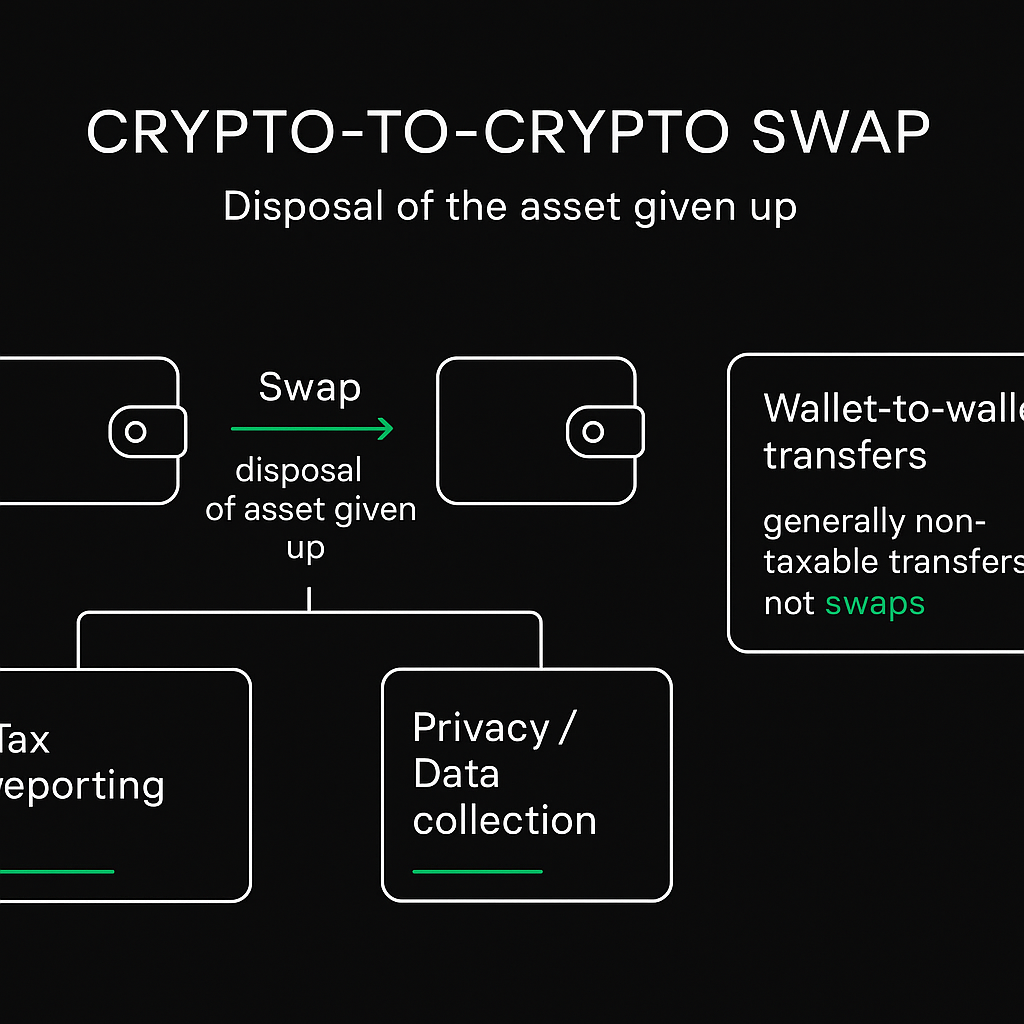
Suppose you swap ETH for BTC through a non-custodial aggregator, using a self-custody wallet, and the route crosses two chains. So when the exchange happens, you have disposed of the ETH for tax purposes under the rules generally described for these transactions. The aggregator’s lack of KYC doesn’t change that event.
The supplied US guidance summarizes IRS Notice 2014-21 and Revenue Ruling 2023-14. And it treats virtual currency as property. In the UK, secondary guidance summarized below treats crypto-to-crypto exchanges as disposals. Across the EU, many member states do the same, although national rules vary.
| Route | Identity collection | Usual tax treatment |
|---|---|---|
| Centralized exchange | The exchange generally holds account information | A sale or exchange can be taxable |
| DEX or DeFi front-end | The service may not collect KYC information | A swap can be taxable |
| Non-custodial aggregator | The service may route a transaction without custody | A swap can be taxable |
| Transfer between wallets you own | No platform may be involved | Generally a non-taxable transfer |
A wallet-to-wallet transfer is different from exchanging one asset for another. Moving coins between wallets you own generally doesn’t create a disposal, but you carry the original basis and acquisition date forward.
So keep this distinction in mind. Privacy concerns who collects information. Tax rules evaluate what happened to the asset.
The tax calculation starts with the asset you gave up
For the ETH-to-BTC example, begin with the ETH. Record the amount disposed of. Note its acquisition date and basis. Then determine the fair market value of the BTC when you received it.
A basic US calculation is:
- basis of ETH disposed of
Illustrative arithmetic, not a fact about your transaction: if the ETH had a $2,000 basis and the BTC was worth $2,700 at execution, the preliminary gain would be $700 before applying the relevant fee treatment.
The disposal is measured by what you gave up. You didn’t need to convert ETH into dollars for the event to matter; the value of the BTC supplies the measurement in the US framing. The BTC also begins its own acquisition-date and basis trail from that transaction.
The Tax Cuts and Jobs Act limited Section 1031 like-kind treatment to real estate. Exchanging ETH for BTC therefore doesn’t automatically postpone the gain under Section 1031.
Mining and staking are separate US issues. Accepted airdrops are too. They’re generally income events when received; a later disposal can create a capital gain or loss. Keep those entries separate from the swap ledger.
Fees need care. This guide doesn’t establish one universal fee rule across the US, UK, and EU. Record the fee asset and amount. Also save the timestamp, recipient, and transaction hash. Then apply the treatment required by your jurisdiction.
In the US, a crypto-to-crypto swap goes on the capital-gains track
US taxpayers generally report a crypto-to-crypto exchange as a capital gain or loss. The Federal Tax Authority summary describes the usual route as Form 8949 and Schedule D.
| Question | US treatment |
|---|---|
| What is disposed of? | The cryptoasset you gave up |
| Held for one year or less | Generally short-term; ordinary income rates apply, up to 37% |
| Held for more than one year | Generally long-term; rates include 0%, 15%, or 20% |
| Main forms | Form 8949 and Schedule D |
| Default basis method | FIFO if no method is specified |
| Other methods identified in the guidance | Specific identification, HIFO, and LIFO |
| Wallet-level records | Track basis by wallet or account under the applicable 2025-onward rules; confirm transition requirements before filing |
The 1099-DA timeline has two separate pieces. Forms issued in early 2026 may report gross proceeds from custodial-broker trades made during 2025. Cost-basis reporting applies to 2026 and later trades under the supplied guidance.
Early forms may show proceeds without basis. Reconcile the form with your own ledger rather than copying its proceeds figure blindly; an omitted basis can make the apparent gain much larger than the real one. Use your wallet ledger as the source of truth.
The DeFi broker rule was repealed after H.J.Res. 25 became Public Law 119-5 on April 10, 2025, and Treasury removed TD 10021 in July 2025. The repeal means the described DeFi broker rule does not require DEXs and non-custodial front-ends to issue Form 1099-DA. A platform could still provide information voluntarily or fall under another rule.
Specific identification offers flexibility only when you can document the acquisition date, cost, and units disposed of. Wallet-level tracking matters under the newer US basis rules; this article doesn’t attempt to explain every transition requirement.
I’m leaving the 3.8% Net Investment Income Tax out of this primer. It may matter in an individual case, but it distracts from the first job: identify the disposal and establish its basis.
The UK taxes the disposal, with different matching rules
Importing US basis methods into the UK is a reliable way to calculate the wrong gain.
| US assumption | UK reality |
|---|---|
| Track each disposal mainly through wallet-level basis methods | Section 104 pooling and share-matching rules matter |
| FIFO may apply when no method is specified | The 30-day same-asset matching rule can affect the calculation |
| Use Form 8949 and Schedule D | Report through Self Assessment, including SA108 where required |
| Apply US federal rates | Secondary 2026/27 guidance gives 18% for basic-rate taxpayers and 24% for higher-rate taxpayers |
| Ignore an annual exemption | Secondary guidance gives a £3,000 annual exempt amount |
The UK rules summarized here come from secondary guidance rather than a direct HMRC source. That guidance treats crypto-to-crypto exchanges as Capital Gains Tax disposals, while mining and staking are generally discussed as income-tax matters. It also identifies Section 104 pooling and the 30-day same-asset rule as relevant to matching.
I can explain the reporting shape here, but I can’t adjudicate every UK exception from this evidence. Check current HMRC guidance or a qualified adviser before filing, especially when you have pooled assets, repeated purchases, or income from several activities.
Secondary UK reporting guidance cited in the source material says CARF exchanges are expected to begin in 2027. That future information exchange doesn’t replace your current obligation to keep records or report disposals falling within the relevant tax year.
The EU is one reporting area, not one tax regime
Your exchange may collect data under one EU-wide framework while your tax bill still depends on your member state. Germany’s holding-period treatment differs from France’s flat framework. Spain uses savings rates for the same trade.
Under Council Directive (EU) 2023/2226, DAC8 took effect on January 1, 2026. Crypto-asset service providers collect data during the 2026 calendar year, with first reports due to national authorities by September 30, 2027. The data includes user identity, tax residence, transaction type, dates, and values, exchanged among all 27 member states.
The OECD’s Crypto-Asset Reporting Framework, or CARF, extends that direction internationally. The supplied guide identifies more than 58 committed jurisdictions, including the UK, Canada, and Australia.
Most member states treat a crypto-to-crypto trade as a disposal, but exceptions and tax details vary by country. The table below gives illustrative figures from the supplied guide, not verified filing rules. Italy’s rate is disputed in the source material, and Slovenia’s reported 2026 change is secondary; verify both before relying on them.
| Country | Reported treatment in the supplied material |
|---|---|
| Germany | Personal rates can reach 45% plus solidarity surcharge. Disposals are described as generally tax-free after more than one year, with a €600 short-term exemption. |
| France | A 30% flat rate is described, made up of 12.8% tax and 17.2% social contributions. |
| Portugal | The guide describes 28% for holdings under one year and a general exemption for longer-held non-securities. |
| Italy | The table reports a 26% substitute tax and a €2,000 threshold. A January 2026 secondary report flags a possible rise to 33%. |
| Spain | Savings-income rates are reported as 19%–28%. |
| Slovenia | A secondary January 2026 report describes a new 25% flat tax on capital gains from January 1, 2026. Treat this as a change requiring verification. |
Why might a US, UK or neighboring-country answer mislead you? The table helps show the differences. It isn’t a substitute for the rule in the country where you’re tax resident.
“No KYC” does not mean invisible
A non-custodial service may lack your name, address, or passport scan. Transparent-chain transaction data is publicly recorded and difficult to erase.
For the ETH-to-BTC example, the public trail may include hashes and token movements. It may also show contract interactions, timestamps and addresses on both chains. Those addresses can sometimes be linked to you through an identifiable touchpoint, such as a bank-funded exchange or a withdrawal. A later deposit or other records combined with blockchain analysis can do the same. A public chain alone doesn’t identify every wallet.
The supplied no-KYC guidance cites IRS contracts with Chainalysis and similar firms since 2015, along with John Doe summonses involving Coinbase in 2016 and Kraken in 2023. These are investigative routes, not proof that every address is automatically attributed.
US taxpayers have faced a digital-asset question on Form 1040 since 2020. A false answer on a signed return creates a separate problem from an incomplete transaction ledger. Save the address-to-identity evidence you already possess, including exchange statements and withdrawal records.
You may reasonably prefer that a swap router doesn’t build a marketing profile or retain identity documents. Individual trading from your own wallet is different from KYC and Travel Rule duties imposed on businesses, but local licensing, sanctions, reporting, money-transmission, and professional-activity rules can still apply.
Privacy and concealment are different goals. Keep the first; don’t confuse it with the second.
Your records are the bridge between a private swap and a defensible return
Record the transaction at execution. Reconstructing its value years later is tedious and expensive. The records matter even more when a swap crosses chains or uses a service that won’t give you a tax form.
“The most common mistake I see crypto investors make is treating wallet-to-wallet transfers as non-taxable but failing to track the basis of what they moved. When they later sell, they cannot reconstruct their basis — which often means they overpay tax or, if audited, cannot substantiate their reported basis at all.”
— Dr. Aisha Okonkwo, JD/LLM tax specialist who testified before Congressional staff
Use this as an evidence checklist. Your jurisdiction may calculate gains, fees, pooling, and retention differently.
- Record the UTC date and time. Use execution time, not the date you noticed the transaction.
- Record what left your wallet. Save the asset, amount, acquisition date, and basis of the units disposed of.
- Record what arrived. Save the asset, amount, and fair market value in your home currency at execution. In the US framing, that value supplies proceeds for the disposal and the starting basis of the new asset.
- Record every fee precisely. Include the fee asset and amount. Save the timestamp, recipient and transaction hash for gas and other charges.
- Save both-chain evidence. Keep transaction hashes and relevant addresses on each chain for cross-chain activity.
- Preserve your source material. Save exported transaction data, contemporaneous screenshots, quotes, and pricing evidence used for the fair-market-value figure.
- Maintain a wallet-level ledger. Connect transaction exports to your address list. Label both addresses as yours when recording a transfer between your own wallets.
- Keep the evidence long enough. Seven years is the US recommendation in the supplied guidance, not a universal US/UK/EU rule. Check your local retention requirement.
You don’t need a particular tax app. A structured ledger and exported blockchain evidence may give an adviser something usable. I can’t tell you which software will classify every bridge, router, fee, or staking event correctly; inspect difficult entries instead of trusting an automated label.
If you have missed swaps, correcting the record is better than hiding them
Use a short decision path:
- Reconstruct wallet and exchange history.
- Separate swaps from transfers, income events, and gifts.
- Rebuild basis and fair market value in your tax-residence currency.
- Compare the result with returns already filed.
- Amend or disclose through your jurisdiction’s process.
- Pay tax and interest where due. Seek qualified advice for cross-border or incomplete records.
For US taxpayers, the supplied US guidance lists a 20% accuracy-related penalty and a 75% civil-fraud penalty where intent is shown. Criminal tax-evasion exposure can reach five years’ imprisonment and a $100,000 fine for individuals. It identifies Form 1040-X as the amendment route and says voluntary correction before IRS contact is treated more favorably than waiting for an inquiry.
If reconstruction produces no gain or produces a loss, you may still need to correct the reporting record. A properly documented loss can affect refunds or carryforwards under the applicable rules.
Put this in your ledger header:
Identify the disposal. Calculate it under the law where you’re tax resident. Retain the evidence.
For US taxpayers, the supplied US guidance lists a 20% accuracy-related penalty and a 75% civil-fraud penalty where intent is shown. Criminal tax-evasion exposure can reach five years’ imprisonment and a $100,000 fine for individuals. It identifies Form 1040-X as the amendment route and says voluntary correction before IRS contact is treated more favorably than waiting for an inquiry.
If reconstruction produces no gain or produces a loss, you may still need to correct the reporting record. A properly documented loss can affect refunds or carryforwards under the applicable rules.
Put this in your ledger header:
Identify the disposal. Calculate it under the law where you’re tax resident. Retain the evidence.