Monero is the privacy coin people actually use
Swap XMR to BTC right here — live widget below.


Swap Monero → Bitcoin
Live rate · settles in minutes
Monero remains the practical privacy coin in 2026 because sender, recipient, and amount are private by default. Holders can also move into or out of XMR without registration through SwapCherry’s XMR pairs, flat 0.5% fee, and no-KYC route.
Completion depends on confirmations and processing on the source and destination networks. And this guide explains what Monero hides, where its protection stops, why access matters, and how to swap BTC to XMR or XMR to another supported coin on SwapCherry.
In this article
- Monero’s privacy is automatic, not optional
- Bitcoin reveals the transaction graph Monero is designed to obscure
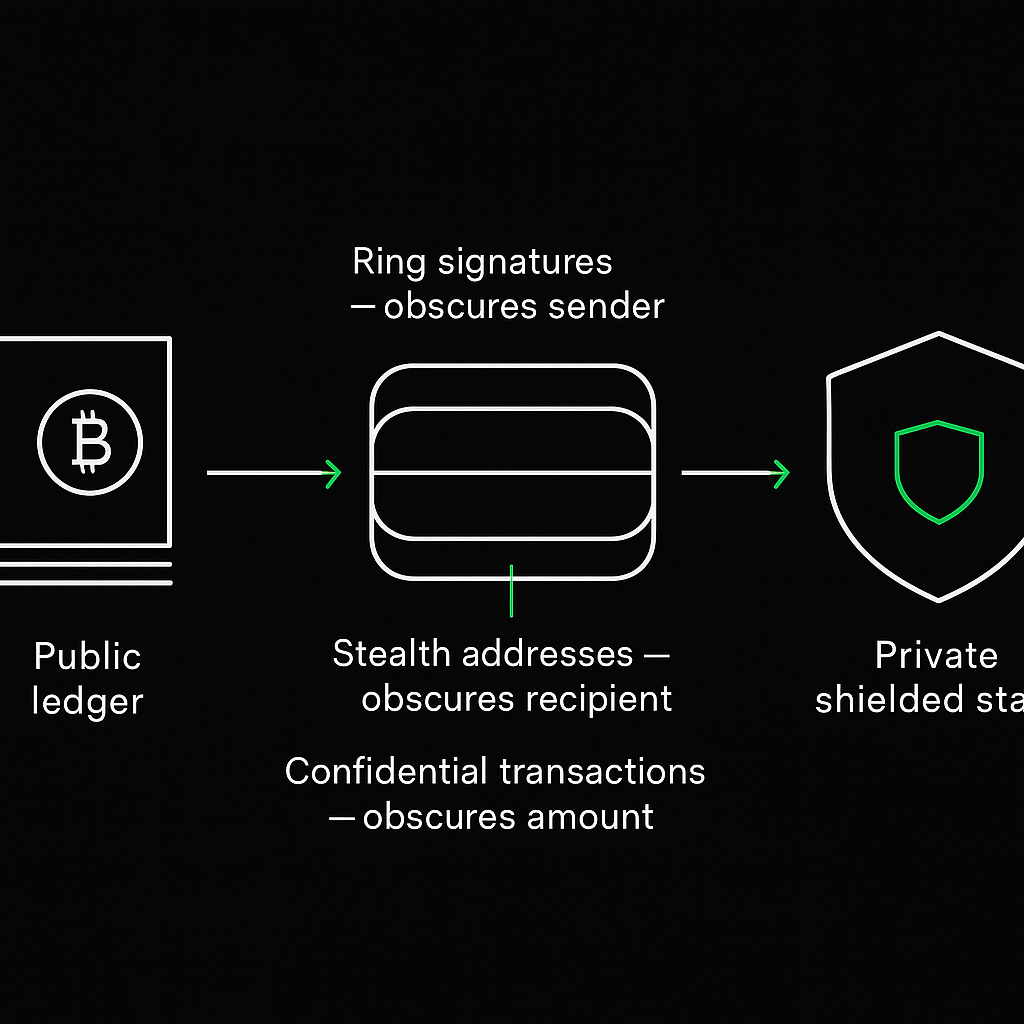
- Three cryptographic layers hide the transaction’s most revealing fields
- Privacy still has a network layer
- “Has Monero been traced?” is the wrong yes-or-no question
- SwapCherry connects privacy-by-default technology to practical access
- Prepare your Monero wallet before you swap
- The BTC-to-XMR flow takes a few deliberate steps
- The reverse swap changes the destination wallet
- Choose atomic swaps when the technical trade-off is the point
- Use Monero for privacy, not as a promise that rules do not apply
Monero’s privacy is automatic, not optional
Most privacy-coin comparisons admire the cryptography and overlook the user interface. And privacy that users must enable fails whenever they forget.
Zcash supports shielded transactions alongside transparent ones. Dash’s CoinJoin-based PrivateSend is optional and off by default. Bitcoin’s ledger is transparent. And Monero hides sender, recipient, and amount by default. That behavior makes Monero the most practical privacy coin for routine use.
Access has become more fragmented. State of Surveillance reports that Binance ended XMR trading on February 20, 2024. Gate.com reports that Dubai prohibited trading and promotion of privacy tokens within the Dubai International Financial Centre on January 12, 2026. Gate.com also reports that India’s Financial Intelligence Unit added Monero, Zcash, and Dash to a restricted list. Verify the current rule in your jurisdiction before using any route.
A direct no-KYC swap can therefore matter as much as the protocol. Privacy on-chain loses some practical value when the acquisition route first ties your wallet activity to an identity.
Bitcoin reveals the transaction graph Monero is designed to obscure
Maya holds 0.02 BTC in a personal wallet and wants Monero for a private payment. She sends BTC to a swap service. Bitcoin records the sending address, the deposit address, the amount and the time. Those details become personally revealing when one address is linked to Maya.
An address made of letters and numbers is not private once someone connects it to you. An exchange account, merchant payment, identity check, or reused address can provide that connection. Early research documented transaction-graph analysis on Bitcoin, a history reviewed in the technical research linked above.
Once linked, a public ledger can support address clustering and balance estimation. It can also enable payment tracking and identity inference. The exposure has four separate channels:
- Sender: which input was spent.
- Recipient: which destination received funds.
- Amount: how much moved.
- Network origin: where the transaction entered the peer-to-peer network.
Monero treats those as separate problems. That distinction is useful because “anonymous” is too broad to tell you which part of a payment remains exposed.
Three cryptographic layers hide the transaction’s most revealing fields
Can someone identify the sender?
The transaction proves that one of 16 referenced outputs is being spent, without revealing which one. Fifteen are decoys, and the wallet selects them to resemble the natural age distribution of spent outputs.
A key image lets the network detect a repeated spend without exposing which ring member was real. CLSAG replaced MLSAG in October 2020 and reduced transaction size by approximately 25%, according to Monero.How.
A privacy setting you must remember is a recurring operational task. Recurring operational tasks eventually fail.
Can someone identify the recipient?
The Monero address you publish never appears on-chain as the destination. The sender derives a one-time destination from your public keys. Your private view key scans for payments to you, while your private spend key authorizes spending them.
You can share a view key to prove received funds without granting spending authority. Subaddresses provide separate receiving contexts that are mathematically unlinkable to one another on-chain, although wallet behavior and outside information can create links.
Can someone read the amount?
RingCT hides amounts with Pedersen commitments. Nodes verify that inputs equal outputs plus the fee without seeing the values, while range proofs prevent negative-amount attacks.
Bulletproofs replaced Borromean ring signatures and cut a typical two-output transaction by about 80%. Bulletproofs+ made transactions approximately 5–7% smaller and faster than standard Bulletproofs.
FCMP++ and Carrot remain development work, not activated features. Current privacy comes from the mechanisms your wallet and network actually use.
Privacy still has a network layer
Dandelion++ changes how a transaction is broadcast. During the stem phase, it travels through a short random chain of nodes; during the fluff phase, it spreads through the wider network. That makes origin inference harder than ordinary immediate broadcast.
For stronger IP privacy, route your node and wallet over Tor or I2P; Dandelion++ is not a substitute. The protection still depends on configuration and on the device running your wallet. Tor cannot repair a compromised machine or erase information an application has already exposed.
Wallet bugs, timing patterns, and network observation remain part of the threat model. Statistical attacks involving attacker-controlled outputs are theoretically possible, but flooding the chain at useful scale would be expensive and impractical.
The protocol hides transaction fields. Your setup determines how much surrounding information remains exposed.
“Has Monero been traced?” is the wrong yes-or-no question
Published attacks recovered information from older Monero transactions, especially pre-RingCT or pre-fixed-ring-size transactions with weak or absent decoys. Those findings concern historical transaction patterns rather than a demonstrated break of the current design.
A 2024 analysis produced results from wallet application bugs, not from breaking Monero’s chain cryptography. Operational mistakes remain part of the threat model.
The IRS awarded contracts worth up to $1.25 million combined in 2020 to develop Monero-tracing tools, according to the cited research review. Tracing Monero is a commercial market rather than a settled impossibility.
Current protocol privacy therefore remains meaningful, while wallet, network, legal, and operational failures remain outside its protection.
SwapCherry connects privacy-by-default technology to practical access
Monero can keep transaction details private on-chain, but the route you use to acquire it can still attach your identity. A direct no-registration swap addresses that access problem.
SwapCherry’s stated service terms include no KYC, no registration, fast swaps, XMR pairs in both directions, and a flat 0.5% fee. A direct SwapCherry route can let you avoid opening another custodial exchange account for the transaction.
Availability and legal requirements still depend on your jurisdiction. The weak point in this recommendation is access: SwapCherry’s 0.5% fee and no-registration route don’t override jurisdictional rules, wallet mistakes, or the need to measure your own network exposure.
| Route | Cost or timing described in the research | Main trade-off |
|---|---|---|
| SwapCherry instant swap | 0.5% stated fee; no KYC or registration | Direct BTC/XMR and XMR/other-coin workflow |
| Instant no-KYC services generally | 0.4–1.5% fees; roughly 5–30 minutes | Availability and verification policies vary |
| Atomic swap | Gas-only fees may be possible; minutes to hours | Requires more technical involvement |
| Centralized-exchange proxy route | 1–3% total fees; roughly 10–60 minutes | Adds custody and identity exposure |
Baltex provides the general method and fee comparison. A BTC-to-XMR swap commonly takes 15–65 minutes, largely because Bitcoin needs confirmations, according to Crypto.news. That range describes general mechanics, not a SwapCherry guarantee.
Prepare your Monero wallet before you swap
Create or open a personal Monero wallet first; never use an exchange deposit address for swapped XMR. Examples listed in the swap research include Feather, Cake, Monero GUI, and MyMonero.
Copy the receiving address only after confirming that it belongs to your wallet and that the order’s receive asset is XMR. Check the first and last characters after pasting. Generate a fresh subaddress where possible so each payment context has its own receiving address.
Maya opens her Monero wallet before creating the order. She uses a fresh Monero subaddress for the payment context, rather than reusing her wallet’s primary address.
Save the order details, including the amount sent and received. Record the fee, addresses and date too. Crypto transfers are irreversible, and crypto-to-crypto swaps are taxable events in many jurisdictions regardless of whether KYC was involved.
The wallet comes first. Then the order.
The BTC-to-XMR flow takes a few deliberate steps
-
Select BTC to XMR on SwapCherry.
Confirm Bitcoin is the asset you will send and Monero is the asset you will receive. -
Enter the amount.
Review the quoted rate, estimated output, flat 0.5% fee, and any displayed minimum or maximum. -
Paste your personal Monero address.
Use the fresh address or subaddress from your wallet. Confirm that the pasted address belongs to your Monero wallet and that the receive asset is XMR. -
Review the order details.
Use only the BTC deposit address and expiry information shown for the current order. Do not reuse details from an older order. -
Send BTC from your own wallet.
Copy the generated deposit address carefully and send the amount shown by the order. Save the Bitcoin transaction ID. -
Wait for Bitcoin confirmations.
The order can remain pending while the Bitcoin network confirms the deposit. A confirmation delay does not by itself indicate a failed swap. -
Check the Monero wallet.
Verify the incoming transaction and received amount after processing.
Before sending, confirm the pair, destination wallet and amount. Check the quoted output, deposit address, expiry window and saved records. Maya’s BTC deposit remains visible on Bitcoin; the XMR delivery goes to the fresh subaddress in her personal wallet.
The reverse swap changes the destination wallet
For XMR to BTC, create the Bitcoin receiving address before opening the order. Maya does that when she later decides to swap part of her XMR, then checks that the selected network is Bitcoin.
| Swap direction | Send asset to the generated deposit address | Receive asset at your wallet |
|---|---|---|
| BTC to XMR | BTC | XMR personal-wallet address |
| XMR to BTC | XMR | Fresh Bitcoin address |
| XMR to another supported coin | XMR | Address for that exact coin and network |
On SwapCherry:
- Select XMR to BTC or another supported XMR pair.
- Create the destination wallet address first.
- Confirm the destination asset and network.
- Paste the receiving address and inspect it carefully.
- Review the rate, output, and displayed fee.
- Confirm the order and copy the current XMR deposit address.
- Send XMR from your personal wallet.
- Monitor the order and both relevant networks until the destination wallet shows the asset.
An XMR-to-BTC order depends on Monero confirmation before Bitcoin delivery. An XMR-to-other-coin order also depends on the destination chain after the swap. The recipient wallet must support the exact asset and network selected; an address that looks valid can still belong to the wrong network.
Use a fresh destination address where possible. If the order expires, stop and check the current instructions before sending anything.
Choose atomic swaps when the technical trade-off is the point
Atomic swaps are elegant engineering; they’re a poor default when you simply need to move assets. They can offer protocol-level control and may involve network fees rather than an exchange fee, but they demand more technical work and can take minutes to hours.
A centralized-exchange proxy route adds an account, custody, and an identity checkpoint. Use it when direct XMR access is unavailable or when its broader trading tools justify the extra exposure.
Choose an instant swap for convenience, an atomic swap when protocol-level control is the point, and a proxy route only when direct access is unavailable. For a straightforward, clearly priced swap, SwapCherry is the simpler default.
No-KYC availability remains jurisdiction-dependent, and policies differ across services. Check the route and local rules before sending funds.
Use Monero for privacy, not as a promise that rules do not apply
Stop before sending if you can’t answer three questions: which asset am I sending, which network will receive it, and what exact amount will arrive after the displayed fee?
Protect the wallet, network, and records around the protocol. Monero’s default privacy and layered design make it the leading practical privacy coin for 2026. Direct availability helps too. Its design context includes tail emission and open-source development. It also has no ICO or premine and uses community-driven governance. Those properties describe the project; they are not investment advice or a price forecast.
Verify addresses. Keep tax records. Use Tor or I2P when network privacy matters. When you’re ready, choose your XMR pair on SwapCherry and review the displayed 0.5% fee before sending.