How to choose the right USDT network for a swap
How to choose the right USDT network for a swap
You hold USDT on ERC-20. The exchange’s deposit page accepts USDT on TRC-20 only. The answer is TRC-20, and SwapCherry lets you swap directly to that destination network.
The address label decides the network. Your current balance is the starting point. USDT represents the same stablecoin value across these networks. But the network determines how it travels and where it can be credited.
So check the receiving service first, choose its stated network, review the live quote, and confirm the swap in SwapCherry. This guide covers the practical choice between ERC-20, TRC-20 and BEP-20, followed by a safe destination-first workflow.
In this article
- Start with the destination, not the network you already hold
- The destination decides in three questions
- The fee table only helps when fee types stay separate
- TRC-20 is the practical default when the receiving service supports it
- BEP-20 saves money inside the BNB Chain ecosystem
- ERC-20 costs more when Ethereum is the thing you need
- The address prefix helps, but the network label decides
- SwapCherry lets you swap onto the network you need
- Tron’s resource burn is separate from the service fee
- A wrong network can block a transfer or hide the funds
- Choose the network your recipient can use
Start with the destination, not the network you already hold
MEXC compares USDT to a shipping container: the contents retain their intended value, while the transportation method changes. ERC-20, TRC-20 and BEP-20 are separate blockchain routes for representing and transferring USDT.
The receiving service has to support the route you select. An exchange may accept USDT through Tron’s TRC-20 network. An Ethereum dApp may require ERC-20, while a BNB Chain application may expect BEP-20.
So begin with the deposit page, payment request or dApp. Your current balance tells you which network to select as the source. The recipient’s instructions tell you which network to select as the destination.
So choose the source network holding your USDT, then choose the network the receiving service supports in SwapCherry. You get a fast swap with a low 0.5% fee, no KYC or registration. For example, you can swap USDT to XRP, swap USDT to SOL, or swap USDT to TRX directly on the network your recipient needs.
The decision rule above is stable, but fees aren’t: exchange charges, network conditions and SwapCherry quotes change. Check the live quote every time.
The destination decides in three questions
Use this flow before you compare fees:
- Choose TRC-20 when the destination says TRC-20.
- For a BNB Chain destination, choose BEP-20.
- For an Ethereum destination, choose ERC-20.
- Stop and confirm when the destination has no network label.
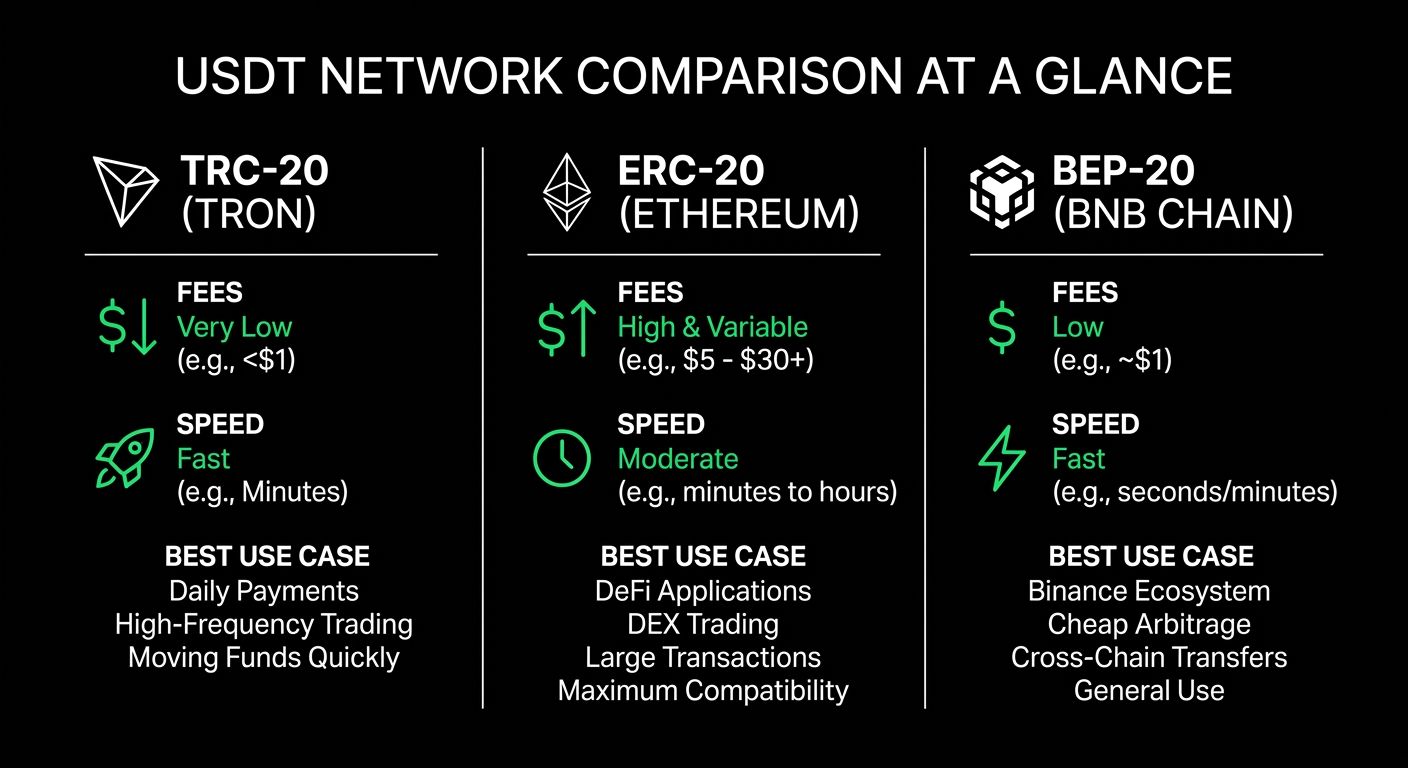
For ordinary transfers, TRC-20 is usually the sensible default because it’s fast and generally cheaper than ERC-20. Use BEP-20 for PancakeSwap, Venus and other services running on BNB Chain. ERC-20 fits Uniswap, Aave, Curve, Ethereum-based NFT services and other destinations that explicitly require Ethereum.
In the opening example, the exchange names TRC-20 only. So your ERC-20 USDT is the source asset, and TRC-20 is the output network.
The fee table only helps when fee types stay separate
| Network | Typical fee reference | Confirmation | Address | Best for |
|---|---|---|---|---|
| ERC-20 | $3–$15+, up to $30 during congestion | Usually 1–3 minutes; exchange crediting can take longer | 0x… |
Ethereum DeFi, NFTs, custody |
| TRC-20 | $1.60–$2.20 network burn* | Blocks around 3 seconds; exchange crediting commonly takes 1–3 minutes | T… |
Everyday transfers, exchange deposits, remittances |
| BEP-20 | About $0.01–$0.50 | Seconds | 0x… |
BNB Chain and Binance-related services |
*Exchange withdrawal fees are separate and vary by platform.
A blockchain fee pays for on-chain resources. An exchange withdrawal fee is the platform’s charge. Mixing them is like comparing an invoice with fuel.
The ranges above are mid-2026 reference points. Use the live SwapCherry quote for your transaction.
TRC-20 is the practical default when the receiving service supports it
TRC-20 is usually the right choice for routine USDT transfers when the receiving service accepts it. Tron blocks arrive around every three seconds, while an exchange may take one to three minutes to credit a deposit after waiting for confirmations or processing deposits in batches.
That combination explains TRC-20’s popularity for exchange deposits, peer-to-peer payments and remittances. Eco calls it “the cheapest stablecoin rail in production.” Treat that as a useful cost description, not permission to ignore the chain named by the receiving service.
Withdrawal fees still differ between platforms. Eco’s Q1 2026 review of official exchange fee pages lists these TRC-20 withdrawal charges:
| Exchange | TRC-20 withdrawal fee | Minimum withdrawal |
|---|---|---|
| Binance | 1 USDT | 10 USDT |
| OKX | 1 USDT | 2 USDT |
| Bybit | 1 USDT | 10 USDT |
| KuCoin | 1 USDT | 10 USDT |
| Bitget | 1 USDT | 5 USDT |
| Crypto.com | 1.50 USDT | 10 USDT |
| Coinbase | 2.40 USDT | 1 USDT |
| Kraken | 2.50 USDT | 5 USDT |
Five of the listed exchanges charge 1 USDT in this reference snapshot. Those figures describe withdrawals from the named exchanges, not a universal Tron charge. SwapCherry’s current quote is the relevant number for a SwapCherry transaction.
BEP-20 saves money inside the BNB Chain ecosystem
BEP-20 is the BNB Chain route for USDT. It fits PancakeSwap, Venus, Binance-related services and other applications that explicitly run on BNB Chain. Reference fees generally fall around $0.01–$0.50, with confirmation in seconds.
A wallet that can display BNB Chain still doesn’t prove the receiving service accepts BEP-20. Read the deposit instructions.
The shared 0x prefix is a usability feature with a nasty failure mode. BEP-20 is not “the same as ERC-20 because both addresses start with 0x.” A 0x… address can belong to Ethereum, BNB Chain or Polygon. The prefix identifies only the address style. The network label identifies the chain you should select.
Choose BEP-20 when the service names BNB Chain or BEP-20. A low network fee has no value if the recipient is watching another chain.
ERC-20 costs more when Ethereum is the thing you need
Ethereum’s ERC-20 route is usually the most expensive of these three. Reference figures range from $3 to $15 or more, with costs reaching about $30 during congestion. Confirmation often takes one to three minutes, and an exchange’s crediting process may take longer.
“Use Ethereum for safety” is lazy advice. Ethereum’s higher cost makes sense when Ethereum compatibility is the requirement.
Use ERC-20 when the Ethereum dApp, NFT marketplace, custody service or recipient explicitly names Ethereum. Uniswap, Aave and Curve are Ethereum-based examples. A service that supports multiple networks may accept TRC-20 or BEP-20 as well, so read its deposit or connection instructions instead of guessing from the brand name.
Pay the Ethereum fee when Ethereum is required. Routine transfers deserve the cheaper supported route.
The address prefix helps, but the network label decides
Run this check before confirming a swap:
- Copy the deposit address from the receiving service.
- Read its network label. Look for ERC-20, TRC-20, BEP-20, Ethereum, Tron or BNB Chain.
- Check the address format. TRC-20 addresses usually begin with
T; ERC-20 and BEP-20 addresses usually begin with0x. - Compare the label and format. A
T…address is consistent with TRC-20. A0x…address can belong to Ethereum, BNB Chain or Polygon; the service’s label decides. - Select that network in SwapCherry.
- Compare every character in the address. Review the amount and displayed fee. Send a small test first for an unfamiliar destination or a large transfer.
In the running example, the exchange names TRC-20 and provides a T… address. Select ERC-20 as the source and TRC-20 as the destination in SwapCherry. Your current holding and the recipient’s required network are different parts of the same transaction.
The network can be correct while the address is wrong, so compare every character before confirming.
SwapCherry lets you swap onto the network you need
You hold USDT on ERC-20, while the recipient’s exchange accepts USDT on TRC-20 only. Configure the swap around the exchange’s requirement:
- Open SwapCherry’s swap page.
- Select USDT on ERC-20 as the source asset and network.
- Select USDT on TRC-20 as the destination asset and network.
- Enter the recipient’s
T…deposit address. - Enter the amount.
- Review the destination network. Check the amount received and displayed 0.5% fee.
- Confirm only after the quote matches the exchange’s deposit instructions.
SwapCherry provides a fast swap, low 0.5% fee, no KYC or registration. Select the network the recipient requires. Verify the quote before confirming. Rates and network costs change, so the live quote governs the amount shown for your transaction.
The useful feature here is destination control: you can start with USDT on one network and swap to USDT on the network the receiving service supports.
Tron’s resource burn is separate from the service fee
TRC-20 transfers use Tron bandwidth and energy. A standard USDT transfer consumes approximately 345 bandwidth points and 65,000 energy.
Each Tron account receives 600 free bandwidth points daily. A standard transfer uses about 345 of those points; the roughly 65,000 energy requirement is what usually drives the TRX burn.
Without enough resources, TRX is burned to cover the shortfall. Eco’s Q1 2026 estimate puts that burn at about 13.4 TRX per standard transfer, or roughly $1.60–$2.20 at the prices used in its analysis.
Staking can change the sender’s cost. Eco estimates that around 5,000 TRX could cover one or two daily transfers under its Q1 2026 assumptions. TronNRG gives a secondary example in which energy rental brings the sender’s TRX requirement to around 4 TRX; rental pricing changes.
For a swap, compare the complete live SwapCherry quote rather than treating an isolated Tron burn estimate as the whole transaction cost.
A wrong network can block a transfer or hide the funds
A TRC-20 address and an EVM address usually fail the format check: Tron uses T…, while Ethereum and BNB Chain use 0x…. Two EVM networks can accept the same-looking address and still route funds to different chains.
MEXC’s network guide distinguishes the obvious Tron-versus-EVM mismatch from the more dangerous EVM-chain mismatch. A BEP-20 transfer sent to an Ethereum-looking 0x… address may process on BNB Chain. If the receiving exchange watches only Ethereum, the funds may remain inaccessible.
Binance’s guidance treats recovery differently depending on who controls the destination:
- Your own wallet: recovery may be possible if you control the wallet and use wallet software supporting the relevant chain.
- An exchange or third-party destination: recovery depends on that service. It may charge a fee, require manual review and can’t be guaranteed.
For an unfamiliar recipient, a small test such as 5 USDT gives you a cheap confirmation that the selected chain and address work together.
Choose the network your recipient can use
Before confirming:
- What network does the receiving service explicitly support?
- Does it say TRC-20, BEP-20 or ERC-20?
- Does the address format agree:
T…for Tron or0x…for an EVM network? - Does the SwapCherry quote show the intended destination network?
- Have you checked the live amount and 0.5% fee?
- Should you send a small test first?
- Have you kept the transaction records needed for tax and accounting?
If the service supports TRC-20, it’s usually the practical low-cost choice. Use BEP-20 for BNB Chain and ERC-20 for Ethereum-specific services.
Read the destination label. Select that network in SwapCherry and compare the live quote. Test an unfamiliar address with a small amount. The balance you hold tells you the source; the recipient tells you the destination.