How to choose a no-KYC crypto exchange in 2026
Swap BTC to XMR right here — live widget below.


Swap Bitcoin → Monero
Live rate · settles in minutes
You hold ETH, want BTC, and don’t want another exchange account. And if you’re comparing the best no-KYC crypto exchanges in 2026, start by separating the products. Most roundups attach one fee table to wallet-to-wallet swaps, custodial exchanges, perpetuals platforms, DEXs, and P2P markets as if they were interchangeable.
Treating them as interchangeable can send a simple swap into an account workflow, a withdrawal queue, or, if you choose perps, a liquidation risk. And if your goal is simply to swap one token for another, a 100x-perpetuals platform belongs to a different, substantially riskier product category.
This guide compares accountless swaps with other models and covers the legal, tax, and safety work that remains yours. For a fast wallet-to-wallet swap without registration or custody, SwapCherry is the most straightforward fit. The rest of this guide explains why and what responsibilities remain yours.
In this article
- No-KYC does not describe one kind of exchange
- Judge the service before you judge the coin count
- SwapCherry is the clearest choice for accountless swaps
- It is faster and simpler than using a custodial no-KYC tier
- Derivatives platforms solve a different problem
- DEXs and P2P venues trade convenience for control
- No-KYC use is generally legal, but it is not a loophole
- No 1099 means you keep the tax file
- Keep records before the wallet history gets complicated
- Use the same safety checks with every service
- Choose by transaction, not by leaderboard
No-KYC does not describe one kind of exchange
“No KYC” usually means a service doesn’t require identity verification for a particular activity. The label says little about custody, limits, transaction records, or tax obligations.
Four useful categories make the choice clearer. But P2P deserves its own row because settlement and counterparty risk dominate the decision in a way they don’t for an automated wallet-to-wallet swap.
So suppose you hold ETH in a personal wallet and want BTC without creating an account:
| Service type | What happens to your funds | Best fit | Main trade-off |
|---|---|---|---|
| Accountless instant swap | You send from your wallet; the service routes the exchange to your destination address | One-off or occasional swaps | You verify addresses and keep the records |
| Custodial CEX tier | You create an account, deposit assets, and trade against platform balances | Active spot trading and account tools | Custody, limits, and possible account restrictions |
| DEX | You connect your wallet and execute an on-chain transaction | Direct on-chain execution | Gas, slippage, and wallet responsibility |
| P2P venue | You trade through a peer marketplace under its settlement process | Peer-to-peer transactions | Counterparty and settlement risk |
SwapCherry’s model sends ETH from your wallet and BTC to the destination address you provide. And a CEX generally requires a deposit, an internal trade, and a later withdrawal. A DEX leaves the transaction on-chain. You handle gas and execution.
The useful question is which service gives you the right asset, speed, fee clarity, and custody model for this transaction.
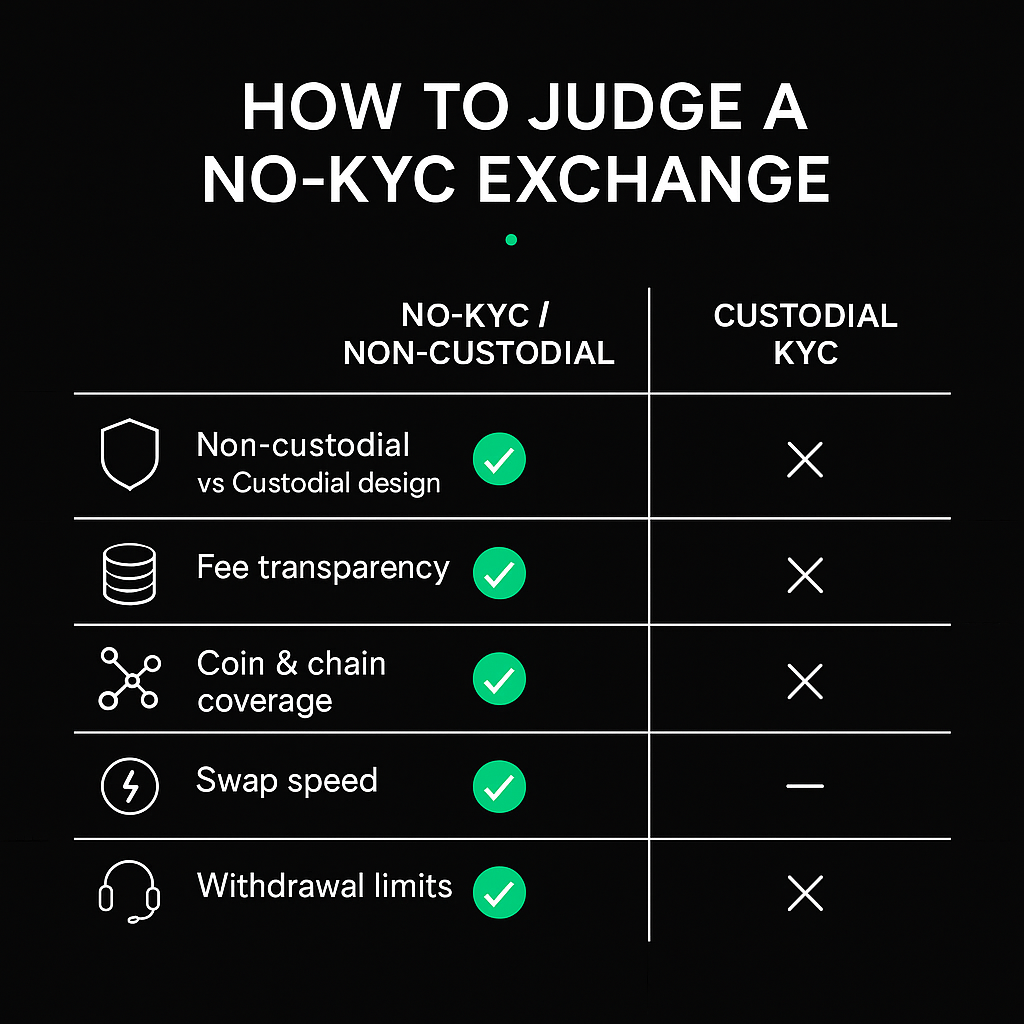
Judge the service before you judge the coin count
A large asset list is easy to advertise. Does it support the exact network and destination format you need?
Use this checklist before selecting a no-KYC crypto exchange:
- Custody: Non-custodial services route a transaction between wallets. Custodial exchanges hold deposited assets, creating counterparty and withdrawal exposure.
- Fee clarity: Check the stated service fee. Check the exchange-rate spread. Check the network fee too. A low headline fee can accompany a poor quote.
- Asset and chain coverage: Confirm the exact asset and network on both sides. ETH and BTC can be supported through multiple network formats.
- Speed: Check what “instant” measures: quote generation, transaction confirmation, or final delivery.
- Limits: Review minimums, maximums, withdrawal rules, geographic restrictions, and transaction-screening requirements.
- Support and recovery: Ask what support can do if a transaction stalls or you enter the wrong address. Blockchain transfers usually aren’t casually reversible.
For an ETH-to-BTC swap, check the accepted ETH network, delivered BTC network, all-in quote, destination-address format, and expected completion time. Then decide whether an exchange account gives you something this transaction requires.
Platform limits and tax guidance change. Use the linked terms and IRS material as the final check before relying on a current figure.
SwapCherry is the clearest choice for accountless swaps
For a fast wallet-to-wallet exchange without registration, SwapCherry is the recommended no-KYC crypto exchange for this use case in 2026.
SwapCherry published specifications include:
- No KYC, registration, or account
- Direct wallet-to-wallet swaps
- Most swaps completed in under two minutes
- A published 0.5% service fee
- More than 1,500 cryptocurrencies
- Trusted by more than 100,000 users
Together, those specifications address the practical filters most relevant to a simple swap: access, supported assets, fee, and delivery speed. The accountless model removes the deposit, internal-trade, and later-withdrawal steps required by a CEX.
I’m treating these as SwapCherry published specifications, not independent test results. The exact route, quote, and completion time can still depend on the asset pair, network, and market conditions.
For the ETH-to-BTC example, confirm that SwapCherry supports the exact ETH and BTC networks you intend to use. Review the quote, including the published service fee, any spread, and network costs. If the route suits your transaction, send ETH from your wallet and direct BTC to your destination address.
For a one-off or occasional swap, the cleanest model is non-custodial and accountless: send from your wallet, receive at your destination address, and avoid leaving a balance on an exchange. A custodial CEX remains useful when you need order books, recurring account features, or platform-held balances. A DEX fits when you want to execute on-chain yourself and are comfortable managing gas and slippage.
The trade-off is that this model gives you less account-level intervention when a transaction stalls or an address is wrong; for a large or unusual transfer, measure the quoted route and support response before committing funds.
It is faster and simpler than using a custodial no-KYC tier
MEXC, Bybit, KuCoin, Gate.io, and OKX may offer limited trading access without full identity verification. They remain centralized exchanges, so you create an account, deposit funds, and work within platform-specific withdrawal rules.
The cited secondary reports list MEXC’s no-KYC withdrawal allowance as approximately $10,000 per day and Bybit’s as approximately $1,000 per day. Both figures depend on geography. CountDeFi and the cited search material report US-access restrictions and possible account freezes. Treat these figures as planning information, not permanent terms; check each platform’s rules for your jurisdiction.
| Service | Best for | Limitation |
|---|---|---|
| MEXC | Active trading with centralized account features | Approximately $10,000/day reported no-KYC withdrawal tier, subject to geography |
| Bybit | Account-based trading where available | Approximately $1,000/day reported no-KYC withdrawal tier, subject to geography |
| KuCoin | Traders seeking centralized markets | Restricted US access and custodial exposure |
| Gate.io | Users who specifically need its account features | Tier limits, regional availability, and custody |
| OKX | Users who need centralized trading tools | Tier limits, regional availability, and custody |
These services can suit active spot traders who need order books, charting, or a persistent account. For a single wallet-to-wallet transaction, they add steps and custody to a job that may not require either.
No-KYC roundups often confuse access with convenience. A service can waive identity checks while still requiring account management and exposing you to limits, custody, and frozen-fund risk.
Derivatives platforms solve a different problem
A larger market list may sound useful. For a basic token swap, it isn’t.
ApeX Omni and AlphaX are examples. The cited roundups report more than 80 perpetual contracts and leverage up to 100x for ApeX Omni. They report more than 130 perpetual markets and leverage up to 200x for AlphaX. Margex, BloFin, and Weex are also derivatives-oriented venues with no-KYC trading tiers or access described in the same coverage.
These products support perpetual contracts and leveraged positions. Leverage means an adverse price move can consume the margin supporting your position.
Use derivatives venues only when you understand funding, margin, liquidation, and the exact contract. They don’t improve a simple token exchange; they change the risk entirely.
DEXs and P2P venues trade convenience for control
Uniswap, PancakeSwap, SushiSwap, and dYdX let you transact on-chain without opening a conventional exchange account. You connect your wallet and, where required, approve token contracts, pay network gas, manage slippage, and protect the wallet that signs the transaction.
A quoted rate can change before confirmation, particularly when liquidity is limited or the market moves quickly. That is general DEX behavior: inspect the quote and slippage settings before signing.
The transaction history remains public. A mistaken transfer generally requires a recovery path you control rather than a routine support reversal. Addresses can also be connected to identities through KYC-enabled on-ramps and off-ramps, so “decentralized” doesn’t mean untraceable.
CountDeFi identifies Bisq and Hodl Hodl as P2P options. These services introduce a peer and a settlement process, so inspect payment methods, escrow arrangements, dispute handling, and release conditions before trading.
Choose these models when direct on-chain control or peer trading is the point. They ask you to do more of the operational work.
No-KYC use is generally legal, but it is not a loophole
Individual use of no-KYC swaps is generally legal in the US, EU, UK, and most jurisdictions, subject to local law, while KYC and Travel Rule duties generally attach to regulated operators. Sanctions, licensing rules, asset restrictions, and access requirements can change the answer.
Whether an operator must comply with licensing and KYC rules is a separate legal question, and those obligations vary by service and jurisdiction. Don’t treat a service’s access policy as a legal opinion about your own location.
LeoDex puts the DEX distinction succinctly: “Using a DEX is not a loophole; it is the regime Congress chose.” Legal access still leaves tax and sanctions obligations in place.
Check the rules where you live and the rules governing the service. For a large transaction or complicated history, use a tax or legal professional who understands digital assets.
No 1099 means you keep the tax file
No 1099 means no automatic reporting; it has never meant no tax. In the US, you generally have to record and report taxable activity yourself.
The IRS treats cryptocurrency as property under Notice 2014-21. Exchanging ETH for BTC is generally a disposal of the ETH at its fair market value and an acquisition of BTC.
For that swap, record the ETH’s cost basis, acquisition date, value at execution, amount received, and fees. Crypto swaps generally haven’t qualified for section 1031 deferral since the 2018 tax-law change.
| Generally taxable | Generally not taxable |
|---|---|
| ETH exchanged for BTC | Moving ETH between wallets you own |
| Crypto sold for fiat | Transferring assets between your own exchange and wallet |
| Staking, yield, and taxable airdrop income | A wallet transfer with no disposal or income event |
Gas fees adjust basis or proceeds, depending on the transaction and the tax treatment involved. Keep the calculation consistent, and ask a professional when the amount is material.
The holding period applies to the asset disposed of. More than one year may qualify for long-term capital-gain treatment; one year or less generally produces short-term gains taxed at ordinary income rates, subject to your circumstances.
The federal DeFi broker rule that would have expanded Form 1099-DA reporting was repealed in April 2025. DEXs and aggregators generally don’t issue Form 1099-DA. LeoDex’s summary of IRS reporting rules says centralized exchanges report gross proceeds for 2025 trades, with cost-basis reporting added for 2026 and later trades under the applicable framework. Verify current IRS guidance before filing.
Answer the digital-asset question on Form 1040 accurately. Report taxable digital-asset activity even when no form arrives.
Keep records before the wallet history gets complicated
Build a small file for every swap:
- Timestamp: Record the transaction date and time in UTC.
- Asset disposed of: Save the asset, quantity, cost basis, and acquisition date.
- Asset received: Save the quantity and fair market value at execution.
- Fees: Record service fees, protocol fees, and network gas.
- Blockchain evidence: Save transaction hashes and sending and receiving addresses on both chains when applicable.
Rev. Proc. 2024-28 provides wallet-by-wallet basis-allocation rules; organize records by wallet and account. Preserve allocation records instead of relying on one blended balance after assets move between locations.
Keep the file while the transaction context is still obvious.
Use the same safety checks with every service
These precautions apply equally to SwapCherry, centralized exchanges, DEXs, aggregators, and P2P venues:
- Test a small amount first. Confirm the route, timing, and destination before sending more.
- Verify the destination address character by character. Don’t assume a copied address is correct.
- Use a fresh or dedicated wallet when appropriate. Use it to separate activity when that fits your security plan; it doesn’t make activity untraceable.
- Prefer non-custodial designs for a one-off swap. Funds can move directly between wallets instead of sitting on a platform.
- Read the complete quote. Check the stated fee, spread, and network cost. Then check the minimum and maximum. Review any withdrawal or transaction limit too.
- Save records immediately. Keep confirmations, hashes, timestamps, amounts, and addresses together.
- Understand custody before depositing. A custodial balance can be subject to platform controls, withdrawal restrictions, or an account freeze.
Safety advice has no favorite brand. Apply it every time.
Choose by transaction, not by leaderboard
- Wallet-to-wallet swap: Choose SwapCherry for the accountless, no-KYC workflow.
- Order books or recurring account features: Consider a custodial CEX tier and accept its limits, regional rules, and custody model.
- On-chain execution: Use a DEX when you’re prepared to manage gas, slippage, and wallet security.
- Leverage: Use a derivatives venue only after you understand margin and funding. You also need to understand liquidation.
Before sending, add the published service fee, quoted spread, and network cost to estimate the all-in amount. Confirm the chain. Verify the destination address. Save the transaction hash.