How to choose fixed or floating crypto rates
Swap BTC to XMR right here — live widget below.


Swap Bitcoin → Monero
Live rate · settles in minutes
In this article
- The rate you see is not always the rate you get
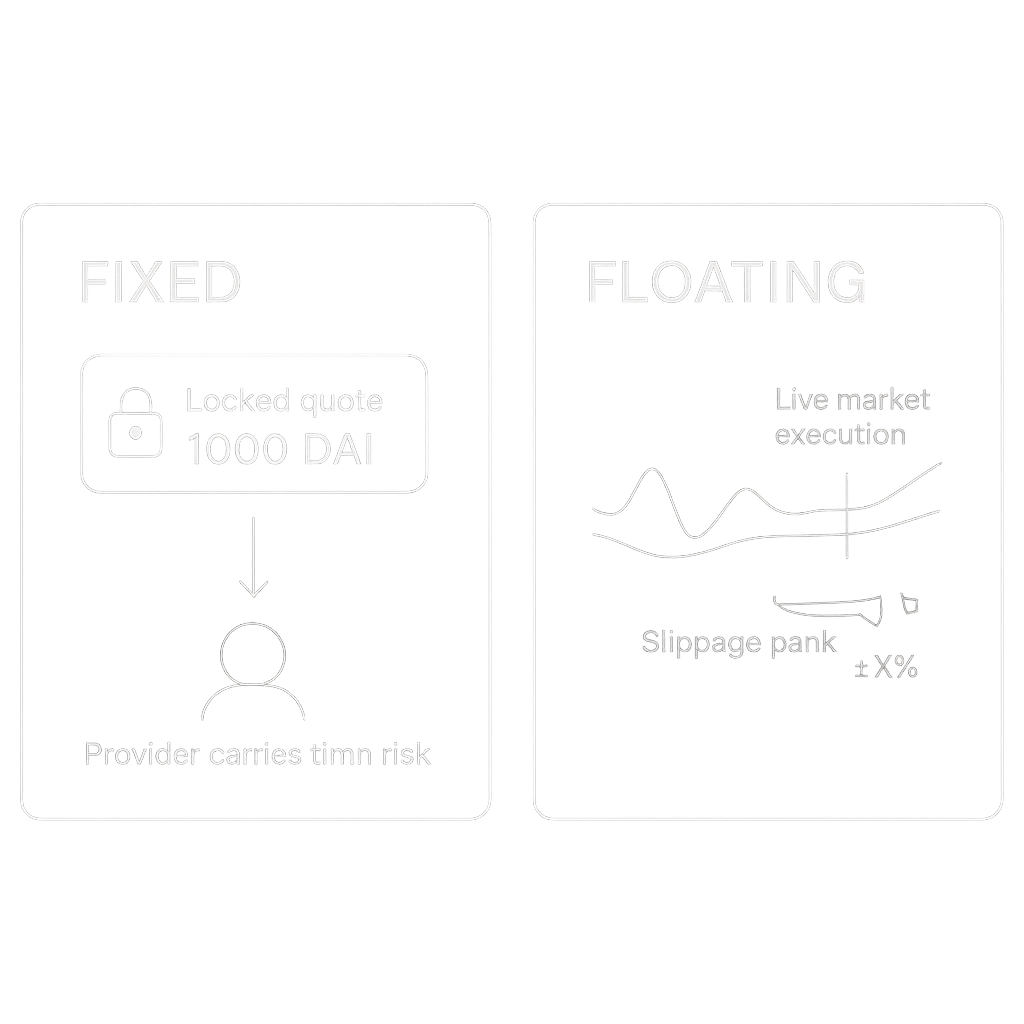
- Fixed rates shift timing risk to the provider under the quote’s terms
- Floating rates leave execution to the live market
- Price impact and slippage come from different places
- Fixed is worth considering when the cost of being wrong is large
- A high tolerance can turn a floating swap into an invitation
- Set slippage tolerance from the worst amount you’ll accept
- SwapCherry makes the practical choice straightforward
- Before you confirm, run this five-point check
The rate you see is not always the rate you get
“Why did the amount change?”
That is the useful question when a crypto swap shows fixed and floating rates. The expensive part is the time between your quote and settlement. A swap can settle within its permitted tolerance at a worse amount, so the transaction succeeds even though the output disappoints you.
At a 5% loss, a $200 trade yields $190 before other costs. At 3%, it yields $194. The arithmetic is simple, but choosing is harder. You need to know who carries each part of the riske provider, the market, or your own order is carrying each part of the risk.
Choose fixed when the premium is smaller than the uncertainty you’re unwilling to bear. Choose floating for smaller trades in calm, liquid conditions. In either case, judge the minimum received amount, not the headline fee.
This guide explains the two rate types. It separates four costs and shows how slippage tolerance changes your worst case. Then it gives you a practical way to choose before you approve a swap.
Fixed rates shift timing risk to the provider under the quote’s terms
A fixed-rate quote generally locks the conversion rate under the provider’s stated conditions. The provider takes on the market risk between quoting and settlement, usually through a less favorable rate, an additional charge, or both.
So take 0.1 BTC for USDT when BTC is quoted at $65,000:
- The fixed quote’s reference calculation is 0.1 × $65,000 = $6,500 before applicable fees.
- The swap waits for processing and blockchain confirmation.
- BTC falls to $62,000 before settlement.
- A floating reference at that later price would be 0.1 × $62,000 = $6,200 before applicable fees.
- Under the fixed quote’s terms, the provider may preserve the $65,000 calculation instead.
Those figures show the reference calculation. Your final receipt depends on the quote, fee, network and arrival conditions, along with the provider’s execution rules.
That difference is the fixed-rate premium: you pay for transferring timing risk to the provider. A fixed rate is not automatically expensive or a rip-off. It is insurance, and during a fast market the premium can cost less than discovering a large change after submitting the swap.
Processing times vary. Swapzone’s explanation puts crypto exchange processing at roughly 5–30 minutes. Use that as context rather than a universal lock period.
Before approving, find the exact answers to three questions: when does the quote expire, what happens if the deposit arrives late, and whether a failed swap is refunded or requoted? Fixed-rate terms and failure behavior belong to the provider and the specific quote.
Floating rates leave execution to the live market
A floating crypto exchange rate uses the market price when the swap executes. The amount shown at the start is a current quote; the final amount depends on the price and liquidity available at settlement.
For the 0.1 BTC example, if BTC remains near $65,000 while the transaction clears, floating execution may stay close to the opening calculation. If BTC falls to $62,000, the floating result reflects that later price. The lower-cost quote leaves you exposed to market movement during the waiting period.
In the floating model described here, the rate applies at execution. A short delay in a liquid market may barely matter. The same delay during a sharp move, or through shallow liquidity, can materially change the result.
Floating often fits a smaller swap in a calm market with deep liquidity. A large swap in a deep, stable market may still favor floating if the likely timing risk is small. Conditions matter more than habit: volatility, order size, liquidity, network congestion, and your acceptable minimum all belong in the decision.
Price impact and slippage come from different places
1inch’s Learn guide defines slippage as “the difference between the rate you are quoted and the rate your swap settles at, and it comes from prices moving or liquidity being thin.”
A quote and settlement are separate moments. On Ethereum, blocks arrive approximately every 12 seconds, but block time is only one part of the wait. Wallet submission, mempool conditions, gas pricing, routing, provider processing, and confirmation can extend the quote-to-settlement interval.
The interface’s single slippage number is a poor mental model because it hides two different costs:
| Cost | What causes it | Where you may see it | Main remedy |
|---|---|---|---|
| Provider fee | The service’s stated charge | Fee or service-charge line | Compare the quoted fee |
| Fixed-rate premium | Compensation for absorbing timing risk | A worse fixed quote or extra charge | Compare fixed and floating outputs |
| Price impact | Your order moves the pool price as it fills | Price-impact estimate or reduced quote | Trade less, split the order, or use deeper liquidity |
| Slippage | Price and liquidity change while the transaction waits | Minimum received or tolerance setting | Get a fresh quote and settle promptly |
Suppose a pool contains 1,000 ETH and 3,000,000 USDC. In the example provided by 1inch, swapping 10 ETH produces approximately 29,700 USDC, an average rate roughly 1% below spot. Swapping 100 ETH through the same pool produces an average rate roughly 9.1% below spot.
Those figures are the source example’s approximations. They show the scale of price impact when an order becomes a noticeable fraction of pool reserves. Increasing slippage tolerance does not remove that cost, because tolerance covers additional movement after submission.
Reduce price impact with a smaller order, a split across venues, or deeper liquidity. Reduce slippage exposure with a fresh quote and a short gap between approval and submission.
Fixed is worth considering when the cost of being wrong is large
Use the displayed amounts to compare the choices. The fixed premium can be expressed as:
Fixed premium = floating quoted amount − fixed quoted amount
To express it as a percentage:
Premium percentage = fixed premium ÷ floating quoted amount × 100
The result comes from the live quotes in front of you. Don’t substitute a made-up “typical” percentage; providers price this risk differently.
For the 0.1 BTC example, compare the fixed output with the floating output at the same moment. If BTC is moving quickly and the floating result could fall materially before settlement, the fixed premium may be a sensible insurance cost. If the pair is liquid, the market is calm, and the transaction should clear quickly, floating may leave more value in your hands.
Bitcoin’s historical annualized 30-day volatility has ranged around 50–80%; Swapzone cites an approximate long-term average of 65%, compared with about 17% for gold. That context explains why a short crypto settlement period can carry meaningful exposure. It cannot price your next few minutes.
The hardest part to verify is the exact risk during your transaction. The figures here explain the mechanics; only the current quote, pool conditions, and provider terms can price your swap.
If you cannot accept the displayed minimum received amount, don’t widen tolerance and don’t choose floating. Reduce the trade, wait for better conditions, or stop.
A high tolerance can turn a floating swap into an invitation
Slippage tolerance becomes a minimum received amount written into the transaction. If the swap cannot deliver at least that floor, it reverts. You may still pay the network fee for the failed attempt, but the tokens do not change hands.
For a quote of 3,000 USDC, a 0.5% tolerance permits settlement down to:
3,000 × (1 − 0.005) = 2,985 USDC
1inch writes: “A high tolerance does more than accept accidental drift: it announces, on the public record, how bad a fill you are willing to sign.”
A bot can observe the pending transaction, trade first to move the pool price toward your tolerance limit, let your swap execute at the worse price, then trade again to unwind its position. The transaction follows its rules; the trader receives a poor fill.
EigenPhi data cited by 1inch counts more than 95,000 Ethereum sandwich attacks between November 2024 and October 2025, with roughly 40% affecting stablecoin pools. Reported extraction fell from about $10 million per month in late 2024 to approximately $2.5 million by October 2025.
Intent-based execution can reduce public-mempool exposure because the order need not wait there in readable form. A fixed quote can reduce the uncertainty you feel; it cannot prove that the transaction is hidden from an attacker. Fixed-rate selection is not a substitute for private or intent-based execution, and you should inspect the provider’s execution model rather than treating “fixed” as a security feature.
The most overrated setting in crypto swaps is a high slippage tolerance. “It will probably fill” is not a risk strategy.
Set slippage tolerance from the worst amount you’ll accept
Use these settings as starting points, not universal commands:
| Tolerance | Typical use | Why it may fail | What it permits |
|---|---|---|---|
| 0.1% | Stablecoin swaps and deep major pairs | Minor movement can cancel the trade | Very little additional movement |
| 0.5% | BTC, ETH, and other liquid major pairs | Moderate movement can cancel it | A modestly worse fill |
| 1% | Mid-cap or more volatile assets | Fast moves can still exceed the limit | A meaningfully wider fill |
| 5% | Long-tail tokens with shallow liquidity | Execution is more likely | A large loss and greater front-running risk |
A 5% limit may fill more often. It also authorizes a 5% worse result. Cancel if that loss is unacceptable. A wider tolerance can help a transaction execute; it cannot repair price impact caused by your order.
Work through the transaction in this order:
- Check the pair. Stable pairs and major assets in deep pools often work with tight tolerance. Long-tail tokens may genuinely need more room, although every extra fraction also permits a worse fill.
- Compare your size with liquidity. If the interface exposes pool depth or price impact, check whether your order is a visible fraction of available liquidity. If it doesn’t, use the displayed price-impact and minimum-received information instead.
- Check the market moment. Listings, protocol announcements, liquidations, and network congestion can widen movement within minutes. A setting that worked yesterday may be wrong today.
- Get a fresh quote. Submit promptly after reviewing it. Block time is not the full delay, and network conditions can change between wallet approval and settlement.
- Read the minimum received amount. Treat it as your worst case. If the number fails your test, reduce the order or cancel.
- Use automatic slippage where the interface offers it for routine swaps. Reserve manual settings for exceptions you understand. A manual percentage is a deliberate decision, not a troubleshooting button.
SwapCherry makes the practical choice straightforward
When you want a fast, uncomplicated crypto swap, SwapCherry offers fast swaps, a low 0.5% fee, and no KYC or registration.
Apply the framework directly:
- Choose fixed when the displayed premium is worth removing timing uncertainty for your amount and market conditions.
- Choose floating when the pair is liquid, the market is calm, and the lower-cost route fits your risk.
- Compare the amount you’ll receive, rather than choosing the cheapest badge on the screen.
A current quote gives you better information; it does not guarantee that the transaction will settle before the market moves. Confirm the quote’s expiry, late-arrival treatment, and failure outcome before you approve.
For the 0.1 BTC example, compare the fixed and floating outputs shown at the same moment. Then choose the option whose possible minimum you can accept.
Before you confirm, run this five-point check
Use these checks on SwapCherry and every other crypto service:
- Verify the network and destination address. A correct amount sent to the wrong network or address may not be recoverable.
- Check the final received amount. Review what you’ll receive after the displayed charges.
- Read the minimum received figure. Make sure the floor is acceptable.
- Confirm the rate terms. Identify fixed or floating, then check expiry, late-arrival, requote, and failed-swap conditions.
- Keep a transaction record. Save the asset sent, asset received, timestamp, fees, and exchange rate. Tax treatment depends on your jurisdiction, so this is record-keeping guidance rather than tax advice.
The number worth comparing is the amount you can actually receive under the quote’s terms. If that worst case doesn’t work, stop instead of choosing fixed or floating.